
Leaving Neverland

I watched the four-hour documentary “Leaving Neverland” with a mixture of emotions – sadness, disgust, horror, and remorse.
Full disclosure – I was a Michael Jackson fan. Posters of the Jackson 5, along with those of the Monkees, David Cassidy, Bobby Sherman, and the Osmond Brothers adorned my childhood bedroom walls. Even as a 7th grader living in a lily-white community, I recognized there was a level of talent in Michael Jackson that transcended the bubble gum pop music that was my staple at the time.
Later when he emerged as a solo artist, I was awed by his music, dancing, and showmanship. Like millions of others, I was mesmerized by “the moonwalk.” While I loved “Billie Jean,” “Beat It,” and “Thriller,” it was “Man in the Mirror,” “Earth Song,” and “Heal the World” that warmed my “let’s unite everyone” heart.
I even liked his fashion choices – not so much the “gloves,” but the military style jackets appealed to me. My friends have often teased me, including as recent as last week, for “channeling Michael Jackson” when I showed up in military-style attire.
Like many fans, I chose to ignore the early rumors about his involvement with young boys. I wanted to believe that the rumors were conjured up by Hollywood tabloids. Even when I watched Oprah Winfrey’s interview with Jackson in 1993, just months before the allegations against him by the family of Jordan Chandler, I rationalized his responses to Winfrey’s questions about sharing a bed with young boys. I wanted so badly to believe his explanation that his lack of a carefree childhood at the hands of a domineering father was the reason he wanted to create a playful environment for young children.
Admittedly, I was troubled when the 1993 allegations were made public. When the case was settled out of court, I accepted the explanation. But, over the years, I watched as his behavior became (in my opinion) more bizarre and erratic. By the time the 2003 allegations against him surfaced, I could no longer deny the signs. By then, I had conducted too many literature reviews of child sexual abuse and rape and talked to too many experts in human behavior after trauma (whether it was violent or not).
When Jackson was acquitted of the 2003 allegations, I was surprised. But, I was more surprised by the reaction of his “super fans” that cheered wildly when the verdict clearing Jackson of all charges was announced. I’m not sure why I was surprised, because we have certainly witnessed similar situations with other celebrities who have been accused of assault (i.e., Chris Brown, R. Kelly).
The reality is that we don’t live in a “black and white” world. There are many brilliant, talented people who are deeply flawed. Given the evidence that has been presented, I believe that Michael Jackson was a pedophile, even though he was never convicted of a crime. And, I’m struggling with how to reconcile that belief with the fact that I still love the songs that I mentioned earlier. As I write this, I’m looking across my living room at one of my most cherished gifts – a vintage Michael Jackson concert booklet that my daughter gave me for Christmas several years ago.
Instead of looking at the complexity of issues, we often resort to the binary “black and white” world, which can cause us to fall into a “blaming” scenario. In the case of rape, we often blame the victim – she “asked” for it because she was drunk, dressed provocatively, etc.
In the case of child sexual abuse, we blame the families of the victims. How could they have not known what was happening? Like most things, it’s much easier to look back and pinpoint the signs or “red flags” in retrospect. Plus, the research shows that the manipulation of the perpetrators makes the signs less obvious than all of us who haven’t been involved in this type of situation understand. It’s much easier to stand in pious judgment from afar.
In the Jackson case, it’s easy to blame his team of handlers for greed as the reason they didn’t speak up or end the abuse they either witnessed or suspected. But, I don’t know their personal or financial situations. I would like to think I would speak up, but I haven’t been in that situation. I haven’t had to sign non-disclosure agreements. I haven’t faced threats or retribution.
Additionally, we continue to see organizations take a “risk adverse” posture and dismiss or hide allegations instead of admitting mistakes and rectifying them (i.e., Catholic church, Penn State University).
It’s easy to place blame after the fact. But, instead of blaming, why don’t we invest more resources in prevention? If we had created an environment where people feel safe in speaking up against wrong doing or organizations weren’t so risk adverse and could admit mistakes, maybe we would have less survivors of abuse and more emotionally healthy adults.
“Leaving Neverland” was hard to watch. But, it is an important story to be told. I hope that instead of focusing on Wade Robson’s and James Safechuck’s graphic description of the sexual acts, that we focus on the long-term emotional effects it has had on them as adults and their families. Maybe then we can stop blaming and judging and start preventing.
That’s my hope and prayer for today. I’ll try to do my part to change the narrative.
Brain Science

“It is never too late to grow up and become who you really are.”
George Eliot
My husband had a good birthday this year. When he was still coaching high school basketball, he would say that he had a good birthday if his teams were still playing on his birthday (his birthday coincides with the high school basketball playoffs in Oklahoma). He’s been retired for several years now, so we can’t credit winning a basketball game for the reason he had a good birthday this year. Honestly, I think it may have something to do with brain science – or more specifically, me understanding, recognizing and using mindfulness to change my emotional reactions to certain situations.
To be honest, science wasn’t really my thing when I was younger. It was my weakest subject in high school. I was born under the Pisces astrological sign, which according to Astrostyle.com is “the dreamer and healer of the horoscope family, who awakens compassion, imagination and artistry, and unites us as one.” Sound familiar? If I had taken an aptitude test when I was in high school or college, I most certainly would not have ended up in a career focused on science or surrounded by a bunch of researchers.
So, here I am today, 30+ years into a career that depends on rigorous scientific measures to evaluate the effectiveness of public health and injury prevention strategies. But, I’m probably late to the mindfulness arena, which is rooted in Buddhist traditions. While it has been argued that the emergence of mindfulness-based approaches is the single most significant development in mental health practice since the beginning of the 21st Century, it’s only been within the past 2 ½ years that I have been introduced to and practicing these approaches.
I should have been paying closer attention earlier because I certainly have had many opportunities in the past 10 years to see the positive effects of mindfulness practice. I used to love working with a retired colleague from California who is Buddhist. His calming presence, composure, and thoughtful, non-threating words in meetings that had the potential to become heated could shift the tension in a nano-second. Several years ago, I was introduced to the Social Emotional Health work my friends at Momentous Institute here in Dallas are doing. Their research is showing amazing results. Ninety-seven percent of Momentous students graduate high school on time, 84% enroll in college, and 79% of children with an identified social, emotional, and/or behavioral challenge show significant improvement in functioning.
We’ve known for some time that traumatic stress has a broad range of effects on the brain and how it functions, as well as on neuropsychological components of memory. The ways that the amygdala, hippocampus, and prefrontal cortex respond to stress are well documented. If some of these terms sound familiar to non-scientists, we heard a lot about this from Dr. Christine Blasey-Ford in September 2018.
Through research, such as the Adverse Childhood Experiences (ACEs) study conducted by the U.S. Centers for Disease Control and Prevention and Kaiser Permanente, we understand the long-term effects of traumatic stress. As a result, many agencies and organizations are implementing a “trauma-informed care approach,” which means treating a whole person, taking into account past trauma and the resulting coping mechanisms when attempting to understand behaviors and treat the patient. I’m happy that my employer, Parkland Health & Hospital System has implemented this approach. Just last week, I completed a mandatory training on trauma-informed care.
There also continues to be a growing body of research that shows that the development of mindfulness, leads to non-judgmental and non-reactive acceptance of experiences, which is associated with positive psychological and physical outcomes. I really got involved in mindfulness because that is deemed an essential leadership component of the Texas Injury Prevention Leadership Collaborative, a group I have been part of for the past 2 ½ years. Besides, who doesn’t want to be less judgmental and more empathetic and compassionate?
What I’ve learned through our mindfulness practice is to listen to really learn and understand instead of listening to plan strategy to counter someone else’s viewpoint. I’ve learned to recognize triggers (physical and cognitive) to emotions and contentious exchanges so that my reactions are less reactive and hostile. It’s very hard, and I am by no means competent at it, yet.
This year, instead of giving my husband a birthday present that I thought he needed or that I wanted him to have (this year’s birthday fail was a towel warmer), I decided to spend the day with him with people he wanted to spend time with and doing what he wanted to do. I made the decision that I was also going to approach the day with a positive attitude, even though his choices for the day were not ones I would choose. Guess what? I ended up having a good day. We watched the Oklahoma University men’s basketball team beat Texas, and then drove to Apache, Oklahoma to watch two high school basketball playoff games. I had enjoyable conversations with people whom I have little to nothing in common. I watched my husband “in his element,” talking with other coaches, administrators, and former colleagues.
As we drove home at 10:30 p.m., my husband expressed an opinion about an issue that is vastly different from my own views on the subject. Instead of reacting immediately, I paid attention to my triggers – I was tired. I paused before speaking, took a breath, and said, “I’m not following what you are trying to say. I’m tired, so this is probably not the best time for this conversation.” Then I just listened as he tried to explain his point. When I did, I began to understand his concerns. I still don’t agree with him, but we avoided an uncomfortable end to what had been an otherwise good day. As we neared our house, my husband looked at me and said, “I’ve had a good birthday.”
On my birthday, my friend, Leslea sent me the “life quote” at the beginning of this blog post. Perhaps, I’m “becoming” the person I want to be, and in doing so, I finally managed to give my husband a present he wanted.


Clarity

Gmorning!
I wish you clarity today.
Clarity of thought, clarity of expression, and a direct
line between what you feel and what to do about it.
Gnight!
I wish you clarity tonight.
Clarity of self, clarity of purpose and a direct
line between who you want to be and how to get there.
Lin-Manuel Miranda
My sister is struggling with a decision. We’ve all been there – worried about the consequences of a “wrong” decision. I recall a story my mother told me many years ago. When my daughter was 3 years old, she was visiting her grandparents for the weekend, and my mother was pushing her to make a decision about something. I don’t recall the details, but they had probably gone to a restaurant, and my mother was trying to get Staley to make a decision about what to order. Exasperated, Staley looked at her grandmother and said, “Nan Nan, ‘cisions are hard.”
Yes, they can be. But, I wonder if our society has made decisions harder because of an “either/or” mentality? Are we conditioned to believe that all decisions are binding, and that we can’t “course correct” if we figure out the original path we selected doesn’t suit us? Does our fear of change put too much pressure on us to never change our opinions, careers, or our minds?
I have many examples in my life that demonstrate how changes have led to better and happier outcomes. Even decisions that may be considered “mistakes” have provided good learning opportunities.
In 2008 (just shy of my 50th birthday), I left a job where I felt comfortable to move across state lines to a city I wasn’t’ familiar with to assume a job that had been successfully held by a very popular, competent woman for nine years. Aside from marrying my husband and having my daughter, that decision may be the 3rd best decision I have made in my life. I love Dallas, love my job, and have met numerous amazing new friends, including the woman that I replaced.
While we laud long marriages, (don’t get me wrong, I’m very impressed with people who have been married for long periods of time; my husband and I will celebrate our 40th wedding anniversary in May), but I have many friends who have had very successful second marriages after divorce.
I think we are also often taught to feel constrained by age, and I think that is big limitation. My friend JoAnn made the decision to leave a lucrative job to start her own business in her 50s. My friend Mary Ann is working to complete her bachelor’s degree in her 50s. My friend Leslea’s parents continued to travel internationally well into their 80s.
Maybe the best thing that we can do is to stop putting limitations on ourselves, shuck societal expectations, and fully embrace opportunities, regardless of when they present to us.
Sonya, whatever decision you make, it will be the correct one. Trust yourself.


It Takes a Village to Raise a Child

I used to say that I had four sets of parents – my actual biological parents, as well as the parents of my closest friends – the Bradshaws, Lawsons, and Wingards. I’m not sure if it was the kids or the parents who became friends first, but we all lived in or near Latta, Oklahoma, a small rural community outside of Ada in southeastern part of the state. The four families had 10 children between them, and we all attended the same small K-12 school where my parents were teachers. All of the women worked, so I was exposed early in life to working mothers. All of the men farmed, whether it was their main occupation or something they did on the side. In those days, I spent almost as much time at the Bradshaw’s, Lawson’s, and Wingard’s as I did at my own house. While I’ve often lamented the lack of diversity in that community, most of my memories of that time are actually happy and fun. Today, I drove back to Ada to say goodbye to the last of the four men I considered as one of my fathers.
During those years, I inevitably spent most of my time in the home of Nancy and Joe Bradshaw because their oldest daughter Vicki was my closest friend from elementary through high school. When we were in elementary school, our houses were probably 1-2 miles apart “as the crow flies.” Since this was a small rural area, it wasn’t “walkable.” There were no sidewalks, just farmland and county roads. But one Saturday when I was probably 9 or 10 years old, I got the idea that if I walked straight out back from our house, I could get to Vicki’s house. This is shocking on many levels, with the first being that I have no sense of direction. Second, there was an empty pasture behind our house with a bunch of trees beyond that. I had no idea what was beyond the trees. But on that Saturday, I enticed my sister to “go exploring” with me, and off we went. Some time later after we had traversed a few pastures, and I had coaxed my sister over a couple of ravines, we ended up on the Bradshaw’s doorstep. When a surprised Nancy opened the door, her first question was “How did you get here?” When I told her, the next question was “Does your mother know where you are?”
Shortly after that expedition and not long after I had gotten braces, I was at the Bradshaw’s for a sleepover. I had eaten several “Sugar Daddy” caramel candies on Friday night (one of the “don’t eat” items for people with braces). I woke up on Saturday morning with the wires on the top and bottom braces intertwined. I literally couldn’t pull my top and bottom teeth apart. When I tried to explain to Nancy what had happened, she expressed no sympathy at my dilemma. None. Nada. Instead her comment was, “Your mother is going to be furious with both of us!” Side note, I don’t think Mom was upset with Nancy, but she was not at all pleased with me. As I recall, we had to wait until the following Monday to get an emergency appointment at the dentist. Lesson learned. I never ate caramel candy with braces again.
By the time we were in high school, the Bradshaws had moved to a farm in Fitzhugh, Oklahoma. One day when I was at their house, Joe came in and announced that he needed Vicki and I to help him “pull a calf.” For those who didn’t grow up on a farm, “pulling a calf” means just that – turning and pulling a calf out of a cow that is in distress or having trouble delivering the calf. Was he kidding? I was incredulous. There was no way I was going to help pull a calf! My dad had never even asked me to do that. Whether it was trying to “one up” Philip Stephens or just a desire to put “prissy” me in my place, but 10 minutes later I found myself in the paddock with Joe and Vicki pulling that calf and all of the messy stuff that came with it. Come to think of it, I may have Joe Bradshaw to thank for me becoming a vegetarian.
During the last semester of our senior year in high school, Vicki and I had a bad case of “senioritis.” We were just too cool for school. We had a free hour for the last hour of the day that we had used for cheerleading practice. But after basketball season ended, there was no need for us to practice anymore. So without permission, we would get in one of our cars and drive to Ada. Evidently, we weren’t quite as smooth as we thought, and one day our high school principal caught us and said something to my dad. Joe liked to tell the story about my dad going to visit him about their “mutual problem.” “Joe, we have a problem with Shelli and Vicki. They’re skipping last hour and going into town.” To which Joe replied, “Philip, during the day when they are supposed to be at school, they are your problem.”
After high school, college and marriages, the paths of our group of friends diverged. Several of us moved away from Ada. For the past 40 years, our paths have crossed only intermittently. Even though I didn’t see them often, the four sets of parents remained friends throughout the years. They were there for my family when we lost my dad. Over the years, we’ve also had to say goodbye to Bob Lawson and Harold Wingard.
Today, I went back to Ada and listened to stories told by Joe’s friends and family. Most of the stories were new to me, but the character of the man they described was very familiar. After the service as my sister and I were hugging Joe’s youngest daughter, Cheryl, she looked at us and said, “Those men are all up there together now.”
Rest in peace, Joe. My life was richer because of your love and support.
Is "Assuming Good Intent" The Answer?

In a previous post I mentioned that, along with my sister, I’ve been participating in Mel Robbins Mindset Reset project. That project has ended, but I’ve been thinking a lot about one of the videos Robbins posted on how we should “assume good intent.” She described it as training our brain to go into a positive default mode. Instead of defaulting to “gloom and doom” when we encounter small injustices, such as someone cutting us off in traffic, instead think, “I hope everything is ok with that person.” She provided an example in the video where she had sent a text message to a friend, but had not received a response back. Robbins said she could choose to create several negative scenarios in her mind, starting with assuming the person is upset with her. Robbins noted that she had no facts to support that the other person was upset or mad at her; that everything about that scenario she had created in her mind. So, if we are going to make up something in our mind sans any facts, why not assume good intent? Robbins said that our thoughts do not actually impact what is happening in the physical world, but fundamentally impact what we feel physically and mentally in our body.
Robbins said when we think something positive about the other person’s behavior that has nothing to do with us, it shifts our mindset from angry to positive.
I like the concept. Two and a half years ago, that would not have been a problem for me. I’ve written about my sister referring to my “Pollyana” viewpoint in the past. For most of my life, I thought that everyone had the best intentions. So, assume good intent – not a problem for me. Then, I woke up on November 9, 2016 to a world I didn’t recognize, and I begin to question everything I thought I knew. So, assuming good intent is not easy for me anymore.
When I began to emerge from the haze of depression and disillusionment, I reverted to an activity that has been my standard in the past – I read as much as I could to try and understand what had happened. One of the articles I read was an Op-Ed that appeared in the New York Times on January 5, 2017 by Robert Leonard, a news director for the radio station KNIA/KRLS in Knoxville, Iowa. In the article, Mr. Leonard talks about how political analysts surmised that ignorance, racism, sexism, nationalism, Islamophobia, economic disenfranchisement and the decline of the middle class contributed to the popularity of Donald Trump in rural America. However, he said that missed the deeper cultural factors that shape the thinking of conservatives who live in rural America.
He said that a turning point in understanding rural America came at a 2015 pre-caucus stop in Pella, Iowa by J. C. Watts, a Baptist minister who was raised in the small town of Eufaula, Oklahoma. Watts was a Republican Oklahoma congressman from 1995 to 2003. That sentence caught my attention because as a University of Oklahoma graduate and fan, I cheered for J.C. Watts when he quarterbacked the Sooners in the 1980s. Mr. Leonard quoted Watts, who was in the area to campaign for Senator Rand Paul, as saying, “the difference between Republicans and Democrats is that Republicans believe people are fundamentally bad, while Democrats see people as fundamentally good.” Watts went on to say, “We are born bad,” and added that children did not need to be taught to behave badly — they are born knowing how to do that. “We teach them how to be good,” he said. “We become good by being reborn — born again.” He continued: “Democrats believe that we are born good, that we create God, not that he created us. If we are our own God, as the Democrats say, then we need to look at something else to blame when things go wrong — not us.”
Let me just say that as a Democrat who was raised in a Christian church, I was NEVER taught that we “create God.” In fact, it was quite the opposite.
Leonard said that Watts talked about the 2015 movie theater shooting in Lafayette, La., in which two people were killed. He said that Republicans knew that the gunman was a bad man, doing a bad thing. Democrats, he added, “would look for other causes — that the man was basically good, but that it was the guns, society or some other place where the blame lies and then they will want to control the guns, or something else — not the man.” Republicans, he said, don’t need to look anywhere else for the blame.
Leonard also wrote about a campaign stop in a neighboring town in 2015 by Ted Cruz when he spoke to grade-school children. Leonard said a couple of dozen children sat at Cruz’s feet, and listened wide-eyed as Cruz told them the world is a scary place, and it’s godly men like him who are going to save them from the evils of President Obama, Hillary Clinton and their fellow Democrats.
Leonard said those interactions gave him a glimpse of the ideas of many of his conservative friends and neighbors. He thought, there’s no wonder Republicans and Democrats can’t agree on things like gun control, regulations or the value of social programs because they live in different philosophical worlds, with different foundational principles.
Ugh. If I was looking for a reason to assume good intent, I wasn’t finding it.
There were a few things that did help me in the months following the 2016 election even as I felt the situation was spiraling out of control every day. My best friend sent me a link to an article written by Robin Chancer, a behavioral specialist, that was published on April 26, 2016, entitled, “How To Stay Sane If Trump Is Driving You Insane: Advice From A Therapist.” Chancer wrote that many people “feel insane because our world is not sane.” Current events are very much at odds with our natural optimism, and our belief in human goodness and progress. Chancer said that even though our nation was founded on idealistic, positive principles such as human worth and dignity, the inevitability of progress, and the goodness of the human collective, there are times when optimism is not healthy, appropriate or possible, and this is one of those times. Chancer suggested ways to cope with the new reality.
Fighting our agony won’t change it. We need to accept what happened, allow it to change us, and work with what is left. This does not mean condoning what happened. It simply means coming to terms with what is, and with what we cannot control. We cannot change that Donald Trump was elected. We cannot change that many Americans are loyal to him in spite of his hatred, or even because of it. We see more clearly the greed rampant in our society. We do well to accept these truths so that we can move forward, rather than paralyzing ourselves with shock and outrage.
If we find ourselves in a place of deep sadness, allow time to feel and honor it. It’s alright to accept that things are as bad as we think. We shouldn’t waste our energy getting mad and upset. Once we fully accept that there are evil things being perpetuated, we can anticipate them, and have a clear mind to plan our next move. Acknowledge that greed and racism are part of our nation’s fabric. We cannot wish them away. Anticipating it will help us stay calm and focused. Once we accept that, we sharpen our focus to guard against their insidious infections. We focus on the work of fighting for human rights and accountability.
In order to promote well-being, we can learn to practice mindful attention both to the present moment and to the good, as we understand it. Faced with a frequently depressing, maddening world, this can mean focusing intently on the inspiring work going on around us in a multitude of spheres. Each time we feel hopelessness creep in, we can focus our attention on the kindness, generosity, and good will around us. We must focus on what we can do, right here and right now.
This was important for me to read. As a natural optimist, I struggled to understand how people I have known and claim to be “good Christians” condone what I perceive to be hateful and divisive rhetoric or racist and misogynistic comments.
I’ve also been reading Margaret Heffernan’s book, Willful Blindness, thanks to another recommendation from my best friend. In the book, Heffernan talks about cognitive dissonance – the mental turmoil that is evoked when the mind tries to hold two entirely incompatible views. It can’t be true that a person can be a Christian and believe in evolution. It can’t be true that a person can value life and support women’s reproductive rights. It can’t be true that a person can support the 2nd amendment to the Constitution and believe that we need policies to regulate firearms. It can’t be true that a person can be a proud American whose eyes well up with tears when the Star Spangled Banner is played and support Colin Kaepernick’s right to kneel during the national anthem. It can’t be true that people who voted for Donald Trump are also good people that care about our country. Or can it? Has society taught us to only think in binary terms – that there are only two options and those are options are mutually exclusive?
In an article posted in Psychology Today on January 27, 2i017 entitled “When Binary Thinking Is Involved, Polarization Follows,” the author Mark Baer said that anxiety from a lack of tolerance for ambiguity leads to binary thinking. He said when the brain reacts in a binary way it leads to quick, irrational decisions and action. Events are construed as dilemmas to be resolved in favor of one alternative or the other. However, Baer said the inherent tension leading to polarization conceals an important developmental opportunity, if we ‘hold’ the tension long enough to permit exploration, differentiation, and resolution by a third, ‘mediating’ element. Healthy groups are not those that avoid conflict and never fall prey to binary thinking and polarization. Rather, healthy groups are those that allow a third element to emerge. With the arrival of a third element, the dynamic shifts from a binary one to—at least potentially —a more balanced and inclusive one.
This is hard, because in addition to reading articles that articulate different viewpoints, I’ve tried talking with people who have different views. Those conversations have not always gone well. The conversations have often been one-sided – I’ve actually been told that there’s no reason to discuss our differences because I’m wrong, or the other person has pointed out all the reasons why I’m wrong and tried to get me to agree. The conversations left me feeling shamed, hurt, dismissed and frustrated. Perhaps, I picked the wrong people to engage in discussion. Regardless, I have chosen to disengage from substantive conversations with these individuals.
I’ve been following the Pantsuit Politics podcast and recently finished the book I Think You’re Wrong, but I’m Listening: A Guide to Grace-filled Political Conversations by the hosts, Sarah Stewart Holland and Beth Silvers. The book has resonated with people so much that many people are purchasing copies of the book and sending it to their Congressional members! I highly recommend both the book and the podcast. Holland and Stewart are teaching me how to re-engage and have “grace-filled” conversations with people whom I have strong philosophical disagreements. Because past conversations have been hurtful, I have to admit that I’m timid about engaging in future conversations. But, I’m committed to trying. I’m trying to be more thoughtful about how I choose to frame my opinions. I’m grateful to the people who have disagreed with my blog posts, but have responded with “grace.” Those people are giving me the courage to try to create safe spaces for uncomfortable conversations.
This week, I got a text message from my sister-in-law that said she was trying to follow my lead and practice positivity. She said there were about two million things that had pissed her off during the past week, but she was focusing on the fact that it was only two million things as opposed to three million! Most days, I feel the exact same way. This is hard work.
Prior to the 2016 election, I would have given myself a big pat on the back for not being a binary thinker. When considering the statements I mentioned previously, it was always “and” not “or.” I believe a person can be a Christian and believe in evolution. I believe a person can value life and support women’s reproductive rights. I believe a person can support the 2nd amendment to the Constitution and believe that we need policies to regulate firearms. I believe that a person can be a proud American whose eyes well up with tears when the Star Spangled Banner is played and support Colin Kaepernick’s right to kneel during the national anthem. But following the election, my thinking was very binary – I found myself believing that anyone who voted for Donald Trump was not a good person who cared about our country. And, I didn’t like those feelings.
After much soul-searching, learning, and therapy, I now believe there is truth in both Mel Robbins’ and Robin Chancer’s words. We can assume good intent and accept the reality that not everyone has good intent. And, I also agree with Sarah Stewart Holland and Beth Silvers that it is important to engage in “grace-filled” conversations with people with whom we disagree. I’m trying to do that.
While I try to adhere to these principles, I will continue to focus on the inspiring work my friends and colleagues are trying to do and what is in our sphere of influence. And, I’ll give myself a pass when I don’t.
#stillaworkinprogress
What have you changed your mind about over the years?

At some point in December 2018, I saw an advertisement on social media about StoryWorth, a company that is being used by families to record their stories and histories. Each week, StoryWorth will send you a question to be answered. At the end of the year, the company will compile the responses and send you a hardcover book containing the stories. I thought it sounded like a great idea (actually, I wish the idea had been mine)! I wanted to capture and preserve stories from my 81-year-old mother and 91-year-old mother-in-law to share with our family. Fortunately, both are indulging me in this endeavor!
The questions are often thought provoking and not ones that I. would have thought to ask. For example, this week’s question is the title of this blog post. I thought it was particularly apropos given the news about photos surfacing of Virginia’s Governor Ralph Northam and Attorney General Mark Herring wearing “blackface” at parties when they were in college. As I understand the details, Governor Northam initially admitted to the incident, then backtracked and denied it. It was reported that in an attempt to get ahead of the story when he learned photos of him in blackface also existed, Attorney General Herring publicly stated that he had “dressed up in wigs and brown makeup” to emulate rappers they listened to at the time. As a result, there have been calls for the men to resign.
Should they resign? I don’t know. I also don’t think my opinion, as a white woman should be considered. I’ll leave that to my African American friends to consider and will defer to their opinions. They are the ones who have suffered generations of racism and oppression.
Are Northam and Herring racists? Again, I don’t know. I do think it’s possible to do stupid things when you are young because it seems harmless and others around you are doing it, and then look back years later and cringe at those activities. I haven’t heard an apology from Northam. What I’ve heard are excuses. Herring did admit to “ignorance and glib attitudes” in his explanation.
There are no “blackface” incidents in my past, but that doesn’t mean I haven’t done or said things that have been hurtful to friends who are of different races/ethnicities, religious beliefs, gender orientation, etc. And, right now, right here, if I haven’t done so already – I sincerely apologize. I have changed my mind about many, many things throughout the years!
I’ve changed my mind because my knowledge and exposure to others with different backgrounds have increased significantly. I spent the first 18 years of my life in rural Oklahoma, attending an all-white school and all-white protestant Christian church. My ideas and opinions at 18 years of age were shaped by those experiences. There were many good things that came out of those experiences. Most of the values I still hold today were instilled in me at home, school, and church. But, some of the things I was taught have also proven to be wrong. And, I’ve discovered, there were many things we just weren’t taught.
Last week during a conversation with my sister, we talked about our shared desire to “keep learning” and “keep improving ourselves.” So this month, I’m attending Black History Month lectures. When I think way, way back to what I learned from textbooks about black history when I was in elementary, junior high, and high school, it was about slavery and the Civil War. Blacks were portrayed in chains working in the cotton fields on plantations. Sure, there were some historical black figures like Frederick Douglass or George Washington Carver that may have gotten a few paragraphs in a history book. But, I wasn’t taught anything about the Africans who calculated and built the pyramids, the sphinx and the obelisks (the Washington Monument is modeled after this). I wasn’t taught that calculus, trigonometry and geometry can all be traced back to African scholars. Why? Let’s be honest – the answer is probably that blacks had no say in what was published in textbooks. There’s an African proverb that says, “Until the lion learns to read, every story will glorify the hunter.” True.
When I hear people wonder out loud why we need Black History Month or Black Lives Matter, it honestly tests my ability to show “grace” to people with different opinions as Sarah Stewart Holland and Beth Silvers talk about on the podcast “Pantsuit Politics.” When I hear whites complain that blacks today have no right to complain “because they have it so much better than their ancestors,” I think about Ku Klux Klan members chanting “You will not replace us” at the riot in Charlottesville, Virginia less than 2 years ago.
As a child, I listened to church leaders praise missionaries who traveled to Africa to save the souls of the savage Africans. I was taught that Africans believed in witch doctors and practiced Voodoo. Yet, many of the alternative medicine methods practiced by traditional African healers, is now being studied scientifically and has been proven effective in treating such conditions as diabetes, high blood pressure, and even AIDS and Ebola.
The more I learn about African culture and black history, the more I’m convinced that “Black Panther” is not a fantasy!
I shared the words on a poster that hangs in my best friend’s church in a previous post, but the words worth sharing again.
The world
in which you were born
is just one model
of reality.
OTHER CULTURES
ARE NOT
FAILED ATTEMPTS
AT BEING YOU;
they are unique
manifestations
of the human spirit.
Wade Davis
Yes, I’ve made mistakes over the years. But, I’ve tried to learn from those mistakes. Often, it has meant shifting my viewpoint on things. My friend Mary Ann frequently uses a Maya Angelou quote when she gives presentations, and I’ve started taking it to heart. "Do the best you can until you know better. Then when you know better, do better." I think there’s a lesson there for all of us.


No Whining

In the winter of 2001, my daughter and I took my nephew (and her cousin) Evan with us on our annual snow skiing trip to Colorado. My daughter Staley, who was 12 at the time, had been skiing since she was 5 years old, but Evan, who was 11, had not learned to ski yet. I also enlisted my friend Mendy to join us on that trip.
Instead of enrolling Evan in ski school when we arrived in Breckenridge, Mendy, Staley and I undertook the responsibility of teaching him how to ski. As is often the case when you are learning to snow ski, you spend most of the time falling down as opposed to schussing down the mountain. Evan was no different. On our first day, his face was in the snow more times than he spent standing up on his skis. But, each time he fell, he got up, put his skis back on, and tried again. Not once did he want to quit (and I gave him many opportunities). Not once did he complain that it was too hard, too cold, too anything. His persistence paid off, and by the second day, he was actually skiing with us.
While Evan never complained, we heard lots of complaining from others on the slopes during that trip. At the end of the first day of skiing, we went into town to have dinner and shop for souvenirs. I don’t remember which one of the trio spotted it first, but they found a t-shirt with the words “No Whining” emblazoned on the front. After that, when we heard someone complaining, we would share a knowing glance and mouth the words “No Whining.” It became the motto for that trip.
Fast forward to the present day. I’ve tried to adhere to the “No Whining” philosophy, but I’m not sure I’ve been that successful. That realization really hit home this week. As I mentioned in a previous blog, my sister has enlisted me to watch Mel Robbins’ Mindset Reset videos for 35 days. The purpose of Mindset Reset is to provide tools to help shift your mindset, which will help in handling stress and quieting anxiety.
As I watched video #24 this week, I was reminded of that 2001 ski trip. The topic for video #24 is “if you want to change your life, you need to stop complaining.”
In the video, Robbins describes three types of complaining. The first is chronic complaining, which actually can impact your health. The second type is venting. I have to admit, I’ve used that term on numerous occasions! She said that venting is useful if it is releasing something inside you. However, it is not productive if you are trying to cram an agenda down someone else’s throat. “I’m right, I’m right, I’m right.” If that’s the case, the venting is just allowing you to spin and is not productive. The third type of complaining she described is just being unaware of how much you are actually complaining – about the traffic, flight delays, the weather, etc. Robbins calls this type of complaining low grade, unproductive complaining. She says that unless you are using the complaining/venting to notice changes that you need to make and taking action to make those changes to be healthier, happier, or more productive, then you are not solving the problems.
In the video, Robbins challenged us to try not to complain for 24 hours, including not complaining to ourselves in our mind or expressing dissatisfaction out loud. Simple, I thought smugly. After all, I’ve had 2 ½ years of mindfulness leadership training with Team Texas.
Uh, not so simple.
By 9:30 a.m. the next day, I had picked up my phone to text my friends Mary Ann and Courtney to “vent” three times. I stopped each time and did manage to make it through the day without expressing dissatisfaction out loud or in a text or email, but I lost count of how many times my mind went to the negative.
How often do I drift to what’s wrong instead of what’s right? How often do I describe the narrative in negative tones and words? How often have I said, “I’m tired, my flight was delayed, I’m working too many hours, etc.,” instead of “I’m fortunate to have a job that I love, my family is healthy, and I have caring, supportive friends?”
When I think back to that 2001 ski trip, I’m reminded of something that Evan said to me at the end of the first day (the one where he spent most of the day face down in the snow). As we were walking into our condo, he looked at me with all the conviction of an 11 year old and said, “This has been the best day of my life.” I smiled at his youthful comment because on that day, at that time, I thought there would be many “best days” of his life ahead. I hope there were. We lost Evan when he was 20. His absence has left a hole in the hearts of all of us who loved him. But, I will always be grateful for the time we spent together and the lessons he taught me on that ski trip. I just need to keep practicing.
#mindsetreset


"We're at the beach."

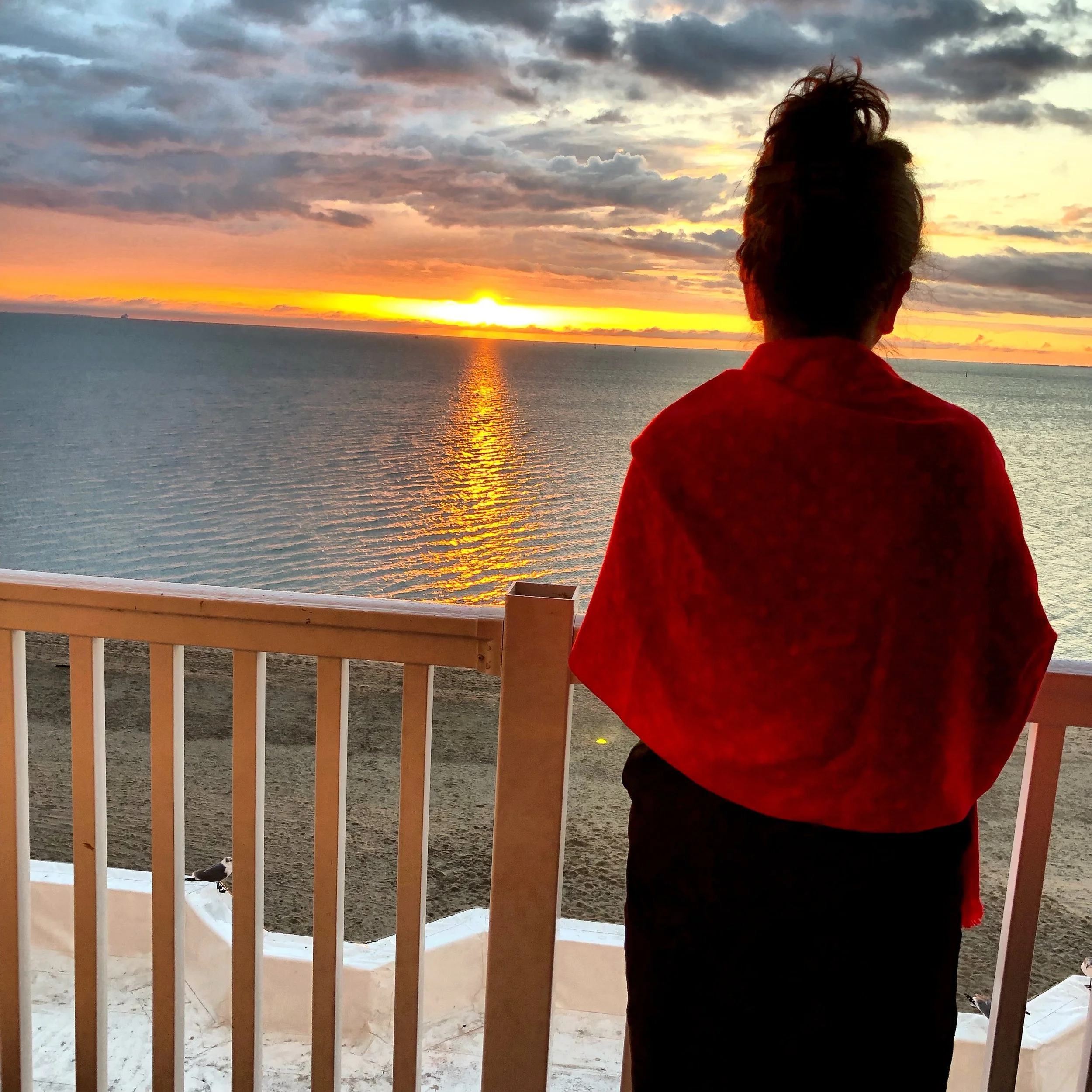
I spent last weekend “at the beach.” I’m not sure if it’s because my astrological sign is Pisces, whose element is water, but I love being at the beach. I am drawn to the sounds of the water, the smell of the salt air, and the feel of sand beneath my feet.
I got to spend the weekend surrounded by the water of the Gulf of Mexico because we had a statewide injury prevention committee meeting on Friday in one of Texas’s coastal cities. Because my “real” vacations have gotten fewer and farther between, I’ve been trying to extend business trips through the weekend. My friend, Mary Ann, who was also attending the meeting, was game to join me for a girls’ weekend at the beach!
I had been looking forward to the weekend, but was a little frazzled when I arrived at the airport on Thursday morning because of some work obligations. For one thing, two back-to-back meetings had been added to my calendar for that day after we had booked our flights. I wouldn’t have time to attend the meetings in person and get to the airport on time, so I asked for a conference line, so that I could participate in the meetings by phone. Because I didn’t want to be going through security with luggage while trying to listen to the calls, I decided to arrive at the airport four hours prior to the flight, so that I could get past security before the first call started.
As a result of the government shutdown, there were only a few security lines open. The TSA agents were patient and trying to move people through the lines quickly. As I neared the front of the line, I heard one of the agents say, “We are doing our best to keep the lines moving and keep everyone safe during the shutdown.” At that comment, the man behind me said loudly, “I don’t know why they’re complaining; they are going to get paid eventually.” It took every ounce of self-control for me not to turn around and rage at the man behind me.
In the first place, the TSA agent wasn’t “complaining.” Second, I have spent my entire career working in government service. While I have never worked for the federal government, I have many friends who do. When I hear people complain about government employees being “lazy,” I bristle. My friends and the people I have worked with and those that I currently work with are intelligent, hard-working souls who often work long hours. Most have advanced college degrees, and most are underpaid because they have chosen a career in public service. As much as I love the work that I do, it would be difficult for me to go to work for 31 days not knowing when I would be paid again. Likewise, it would be difficult for me to be indefinitely furloughed. There were many times in my career when I lived paycheck to paycheck, so I have great empathy for those who were impacted by the shutdown.
I kept my composure and didn’t yell at the man behind me. It wouldn’t have made any difference in his opinion if I had, and it wouldn’t have made me feel good if I had stooped to his level. Instead, as I passed through security, I thanked the agents for their service. And, I may have said it loud enough for others in line to hear!
I can get dismayed by the actions and words of others. But, there are also things that give me hope for humanity. On Friday morning, we stopped at Starbucks on our way to the meeting. As we entered Starbucks, there was disheveled man sitting at a table near the door. He mumbled something that I couldn’t quite hear. I’m ashamed to admit this, but I ignored him. When I was waiting for my order, I saw Mary Ann take a sack over to the man. Instead of ignoring him, she had ordered him something for breakfast. Witnessing her gesture of kindness completely shifted my mood for the entire day and weekend!
When I had made our hotel arrangements for the weekend, I had done so in haste. I booked the first Marriott/Starwood property that popped up on my screen without considering location or walkability – both of which are important to me. When we arrived at the hotel, we found that there were no good restaurants within walking distance – something that is important to Mary Ann. We also weren’t close to the beach – which is important to both of us. After our friend and colleague, Kevin left after our meeting on Friday to return to Austin, Mary Ann and I took a Lyft to the downtown area, so that we could walk along the beach. I considered suggesting that we try to change hotels to one closer to the beach, but was hesitant because I’ve been told that my propensity to move from one place to the next makes it exhausting to travel with me. In the end, I suggested it anyway. Mary Ann looked at me and said, “That’s a great idea!” Before I had a chance to register my relief, she had booked us beachfront Gulf view hotel rooms for the next night. We all need friends like Mary Ann in our lives.
For the 48 hours, if something threatened to spoil our mood, we’d look at each other and say, “It’s okay – we’re at the beach.” Couple that with lots of wine and girl talks, and it was the perfect prescription to recharge.
By the time we boarded our flight to return to Dallas/Fort Worth, we had heard the news that the government shutdown had ended. At least for now, that’s one more reason to be grateful.













Women's March 2019

“If I cannot do great things, I can do small things in a great way
-MLK
On January 20, 2017, I had planned to be in Washington, D.C. I had purchased airline tickets for my daughter and me in October 2016, as had several friends of mine from across the country. Some were coming alone; others were bringing their daughters. We were going to watch the Presidential Inauguration together at my best friend’s house in Baltimore.
But November 8, 2016 happened, and I sunk into a deep depression. A few days later while in Maryland with my best friend, we learned about the first Women’s March in DC scheduled for the day after the Inauguration. “Don’t cancel your tickets,” my friend said. “Come to DC, and we’ll march.” For a moment, I felt a flicker of energy. “Okay,” I said. “I’ll come, and we’ll march.”
When I returned to Dallas after that weekend, I emailed the other friends who had planned to celebrate with us to let them know of our plans. Some of them agreed to join us. But as the days and weeks passed, I remained in a depressed funk that I couldn’t shake. My husband who has always been supportive of my independence and career, but has never been a fan of Hillary, was exceptionally supportive after the election. However, I could tell that he was concerned and growing weary of my melancholy spirit. My family and friends were also concerned. Finally, right before the holidays, I texted my best friend and told her that I wouldn’t be going to DC to march. She understood. She was feeling the same way. I emailed my other friends with my news, and learned they were also having the same feelings. Normally, a chance to spend time with my best friend and others whom I care about, even under bad circumstances, would have generated some excitement for me. But it didn’t in December 2016.
When my friend Sue heard that I wouldn’t be going to DC, she invited me to march with her in Oklahoma City. I also considered going to Austin for the March there, but couldn’t muster enthusiasm to do either.
On the day before the Inauguration, I learned from a colleague that a Women’s March was scheduled for Dallas. The Dallas March was scheduled to begin at Dallas City Hall – 8 blocks from my apartment. Even in my state of despondency, it just felt wrong for me to pull up the covers and stay in bed that day. So, I walked to City Hall. I wasn’t alone. There were several people on the street that seemed to be heading in the same direction. I felt somewhat encouraged. The Dallas Women’s March website had said to start gathering at City Hall by 9 a.m. for the 10 a.m. March time. I arrived at 8:45 a.m. (thank you, Gary Stidham, for making me so punctual). There were several hundred people gathered. The signs were creative. So, armed with my camera, I started taking photos. Then something magical happened. I looked up from my camera, and the crowd had grown. Thousands and thousands of people were descending on Dallas City Hall. A kaleidoscope of individuals and families – black, white, brown, red, yellow, Christian, Muslim, Jew, men, women, young, old, middle-aged, homosexual, heterosexual, healthy, physically impaired, etc., etc., etc.! I had goose bumps!
Then we started marching. We marched peacefully to the Communications of America Hall for 2.1 miles (approximately 8,870 steps). We passed Dallas police officers who were there to protect us as they smiled and waved holding roses. We passed cars as the drivers (men and women) honked their support. We passed people holding signs and cheering standing along the street. I checked social media, and found friends in Oklahoma, DC, California, Austin, and other countries posting the same solidarity and turnout for Women’s Marches.
By the end of that day, there were cracks in my depression. I could have flown across the country to spend the day cocooned with my best friend, but I had found hope and inspiration in the form of kind, caring, and loving people in Middle America.
And, that’s why I’ve continued to participate in the succeeding Women’s Marches – to find hope and inspiration and strength.
I’ve always been inspired by the words of freedom and equality, that appear so eloquently in the U.S Constitution and the Bill of Rights, yet I understand that this country has a long history of injustice and oppression. When I hear white people say they don’t understand “why blacks are complaining because they have it so much better now than in the past” or when whites rage against the term “black lives matter,” I know there’s still so much work to do.
When I see a video of Utah Senator Orin Hatch laughing at women who have suffered sexual assault and telling them to “grow up,” I know there’s still so much work to do.
When I read remarks made by former Michigan State University interim President John Engler that survivors of Larry Nassar’s sexual abuse were “enjoying” their moment in the “spotlight,” I know there’s still so much work to do.
Call me naive, but this country bears little resemblance to the one I thought existed prior to November 8, 2016. But, I still believe the country I imagined can be a reality someday — one that celebrates diversity and equality. And, I need hope and inspiration to build the strength to continue to do the small things to ensure my dream becomes a reality.
This year when Sue invited me to march in Oklahoma City, I got in my car and drove the 206 miles north. As in previous years, I found hope and inspiration in Middle America. But this year, I got to share the experience with my friend, as well as my sister and niece. We marched to honor the women who have broken down barriers and made cracks in the glass ceiling for us. We marched to honor our work in that effort. We marched for our mothers, our sisters, our daughters, and our friends. And, Sonya, McKenna and I marched for a little girl who will be born into our family in April. We marched that she may know equality.
Thanks Sue, Debbie, Paula, Sonya and McKenna.
“Here’s to strong women. May we know them. May we be them. May we raise them.”


Mindset Reset

I was in a meeting this week when the person facilitating the meeting asked all of those in attendance to announce our 2019 resolutions. I had had a very stressful day at work, and this was my last meeting of the day. The request made me feel anxious and irritated. For many years, I’ve made resolutions – exercise more, lose weight, try something new every month, read 75 books in a year, drink 8 glasses of water every day, etc. But I chose not to make any resolutions this year. It’s not that I have difficulty keeping resolutions; I don’t. With the exception of drinking 8 glasses of water every day, I kept the other resolutions. But, the past couple of years have been stressful at work, and honestly, I just didn’t want the added pressure of having to think of a New Year’s resolution.
Then, my sister mentioned that she and my niece are doing Arbonne’s 30 Day Healthy Living Reboot. It’s not a diet (although my sister and niece have lost weight and inches and look fabulous), but more of a commitment to eat foods that support nutrition and eliminating those that hinder digestion. Like it or not, as we age, our bodies don’t tolerate the same foods we could eat in our younger years. Since I’m not a foodie or a cook (my sister got those genes), I don’t have a problem not eating many of the processed foods I ate in my youth. When I became a vegetarian 20 years ago, I pretty much made a commitment to healthier eating.
As part of the Healthy Living Reboot, my sister and niece are also participating in a free 35-day Mindset Reset, offered by author and motivational speaker, Mel Robbins. It’s not that I can’t benefit from healthier eating, but I definitely needed to reset my mindset! Plus, it sounded like a good complement to the mindfulness work I had been doing with the Texas Injury Prevention Leadership Collaborative. So, I agreed to do the Reboot and Mindset Reset with my sister and niece.
The Mindset Reset includes daily 20-30 minute videos and emails from Robbins to help train your brain to make small shifts in your mindset, reduce anxiety, and handle stress. I watch the videos in the evening just before getting into bed. I have to say, the tips have been helpful.
But after an already long stressful day, I was irritated with the request to “announce my 2019 resolution.” Then, I started getting emails for last-minute work requests, which meant that I was going to have to work late – again. By the time I got home, I was frustrated and frazzled. I’m not proud of this, but I responded to a text my sister sent with how ******* my day was. She texted back, “You should watch today’s Mindset Reset.” Are you kidding me? I wanted to open a bottle of wine – not add one more thing to my “to do” list.
But, I took a few deep breaths. And, I watched the video. And, I felt better.
In one of the videos, Robbins talked about having an “Unfollow Friday.” She suggested “unfollowing” any social media accounts that do not support your values or make you feel good. She said your social media channels should inspire, empower, entertain, educate and support you. Hearing this was validation for an act that I did on November 9, 2016. When I awoke that day, I was despondent and felt viscerally ill. In spite of how I felt, I got up and went to work. I spent most of the day in a daze, as did many of my staff and other colleagues. Probably the only productive thing I accomplished that day was to “unfollow” anyone on Facebook who posted vile comments about Hillary Clinton or positive comments about Donald Trump. I got a lot of negative comments about doing that from Facebook “friends” in Oklahoma who were offended by my action, but clearly didn’t really know or care about me.
When I saw Robbins video, I felt it gave me permission for my actions that day. I felt validated.
Clearly social media is here to stay, but the content doesn’t have to control our lives. We have the ability to choose inspiration over hate. We have the ability to reset our mindset.
Perhaps, I have a 2019 resolution after all.


New Orleans (aka #TCAA 2018)
November 18, 2018
It’s taken awhile to post photos from my trip to New Orleans in May for the Trauma Centers Association of America Annual Conference. As I’ve trying to do, I took an early morning flight and spent the afternoon before the conference wandering around the French Quarter with my camera.


We can’t “fix it” alone

Last summer, I had a conversation with my husband, his brother, and his brother’s wife, about societal changes (among other things). My brother-in-law expressed sadness and frustration about the changes he is witnessing in his hometown community. Prior to our conversation, a newspaper article had been published with statistics from the National Center of Health Statistics that showed that of the seven American towns or neighborhoods with a life expectancy below 60 years, three were in eastern Oklahoma. – one of those three was my husband’s hometown, and the community where most of his family still resides. To put this in perspective, the national life expectancy is 78.69 years. In Dallas (where I live), the life expectancy mirrors the national numbers at 78.29, while in Edmond, Oklahoma, the life expectancy is as long as 84 years. The reasons for the decline in health are varied and complex, including poverty, poor lifestyles, and low education rates.
I understood why my brother-in-law was upset. My husband’s family is deeply rooted in their eastern Oklahoma community. Generations of the family have lived in that community. There’s even a smaller community 25 miles away that bears the family surname. My brother-in-law was embarrassed by the health rankings, as well as the reasons listed above, but he was also worried about other things that often plague small communities – the perpetual flight of young, educated people leaving these communities. As he was telling us about his concerns, he said that he and his son (who also lives in the community) often talk about these issues. “We just don’t know what the answer is to reverse the trend,” he said.
No offense to my brother-in-law and nephew who are both smart, college-educated men, but it is highly doubtful they will find the solution while they are constrained by the four walls of their offices!
Not long after this conversation, I picked up the August 2018 issue of Texas Monthly and read about how “A New Generation is Reviving Small-Town Texas.” The article highlighted several small towns in Texas that are thriving because young people are “ditching the big city to foster a rural renaissance across the state.” This isn’t just happening in Texas. Last summer, my sister-in-law went on a solo-driving trip to meet me in Utah. Along the way, she stopped and spent the night in small towns in Colorado and Idaho. When we met up in Utah, she told me about enjoying some of the weekly outdoor evening entertainment held in parks or town squares in these towns, all about the size of her own Oklahoma community. The small towns that my sister-in-law visited, much like the ones in Texas, all had something that made people want to visit and live there.
When I was in Oklahoma recently for the holidays, I picked up a copy of The Next American City: The Big Promise of Our Midsize Metros, which was written by Mick Cornett, a four-term mayor of Oklahoma City. Cornett began his first term as mayor in 2004 when I still lived in Oklahoma, so I was interested in what he had to say.
Cornett set the stage for the revival of downtown Oklahoma City by telling the story of former Mayor Ron Norick’s efforts to get United Airlines to build a maintenance facility in OKC in 1991. Even though Norick had put together an attractive incentive proposal, United Airlines ultimately chose Indianapolis as the site for the facility. As Cornett describes it, Norick was deflated. Yet, instead of complaining and “licking his wounds,” Norick wanted to understand what OKC could have done better to secure the maintenance facility. So, he continued conversations with United Airlines. Norick wanted to “learn” from his mistakes. What he learned was that, unbeknownst to Norick and local leaders, a handful of mid-level United executives and their spouses had visited downtown OKC for a weekend. And, they didn’t like it. Downtown OKC was dead. They couldn’t imagine having to live there. In the end, it didn’t matter how good the proposal or incentive package was, the quality of life in OKC had doomed the deal.
Now, here’s the important part of the failed attempt to land the United Airlines maintenance facility, and in my opinion defines true leadership – Norick and local leaders used the lesson to improve their city. Within three years, those leaders had charted a new plan, and “Metropolitan Area ProjectS” or MAPS was underway. If any of those United Airlines executives were to visit downtown Oklahoma City today, they would find it unrecognizable from the city they visited in 1991. In fact, I’m surprised at the continued growth and changes, and I visit there often!
While Norick may have been the catalyst to downtown Oklahoma City’s revitalization, it’s important to note that he alone didn’t “fix” the city’s problem. It took “a village” of OKC political and business leaders, among others to address the issues and make the changes. The progress didn’t end when Norick left office. The mayors that succeeded him (including Cornett) were just as committed to continued improvement. Once the culture has shifted, it’s easier to let the momentum continue.
In the public health field, we never start a project without first looking at the literature to find out what has worked and not worked in the past. Resources (financial and human) are too limited to waste them on doing something that has been proven to be ineffective. Likewise, Norick and his successors visited other cities and talked to other mayors to find out what was working in their communities. Much like the book, Positive Deviance, they focused on what was working well, instead of focusing on the problems. Isn’t that a lesson for all of us?
I think I’ll send my brother-in-law a copy of Cornett’s book.

Hello 2019

January 6, 2019
Awaken ancient forms and play within them,
Sift gold amidst the wreckage of your slumber;
Renew your passions, maybe Pinterest pin them,
Tell that one toxic friend, “Yo, lose my number.”
The day is clear, a new year is aborning;
And so are you, perpet’ually. Gmorning.
Find words for all your daily joys & terrors.
Gnight; make work that gets us in our feelings.
Send off to bed your doubt, your shame, your errors;
Break curfew with your muses, shatter ceilings.
The year is fresh; wipe clean inertia’s mildew.
Grateful for all you do, & all you will do.
Lin-Manuel Miranda
Gmorning, Gnight! Little pep talks for me & you
The start of a new year usually brings hope – the promise of new beginnings to start fresh; to dust off the cobwebs of unfulfilled resolutions from the previous year. At least, that’s what it has meant for me. With the lone exception of 2017, I have entered each New Year with anticipation and excitement for the “newness” of impending opportunities.
Although some events have robbed me of the unfiltered optimism I once had, there are people who have rescued my hurting heart and restored my faith in humanity. They are the ones who remind me that perseverance is worth the effort.
There are several moments during the past few weeks that have given me inspiration, including reading Gmorning, Gnight: little pep talks for me & you by Lin-Manuel Miranda, a gift from my dear friend, Mary Ann. Expect to see several quotes from that book in future blogs!
I’ve also been inspired by the writings of family and friends. I hope she doesn’t mind me sharing this, but the following social media post from my niece, McKenna, filled me with pride.
“For me, 2019 is going to be about being better. Being a better human, a better friend, a better sister, a better daughter, a better leader, a better writer (by actually writing) and being the best aunt to the little girl who makes my eyes flood with the happiest tears every time I think about her (and she's not even here yet!) I want to be a better person most importantly for myself but also for the incredible people in my life. Roll your eyes if you want to, but here's to another year of life, here's to 2019.”
Not long after I saw McKenna’s post, I received the annual holiday letters from my friend, Anara, and her husband, Dave. Both are gifted writers, and I look forward to their letters each year. Anara’s letter this year is a reminder to me that better times have prevailed in the past when the present reality has been cruel and dark.
“The glow of menorah candles, growing more numerous and brighter each evening, remind us of miracles, as does the gleam of a single star that guided travelers through the night.
The need for illumination seems a fitting metaphor for our times—so many of us are burdened by darkness.
A fetid stench festers within our democracy, and the putrid miasma of hate makes us ill. Gloom pervades the daily news and taints us, like ink spilling across our desks, staining all that it touches.
As Petrarch wrote, "My fate is to live among varied and confusing storms. But for you perhaps, if as I hope and wish you will live long after me, there will follow a better age. When the darkness has been dispersed, our descendants can come again in the former pure radiance."
I take comfort in knowing that the Dark Ages did not last; they gave way to the Renaissance... and then, to the Age of Enlightenment.”
I’m also finding hope in some unlikely sources. I recently read an opinion piece from Mark Wingfield, an associate pastor at Wilshire Baptist Church in Dallas. When I shared the article with my friend, Debi, her comment was “You are reading something by a Baptist???” Debi knows my disappointing history with the Baptist church (see my October 14, 2018 post, A Tale of Two Churches). Her surprise at my reading the article is legitimate. A year ago, I probably would not have opened a link from Baptist News.com because of my own bias. While reading Pastor Wingfield’s words made me feel hopeful, it was also a reminder to me that I need to spend more time listening and learning from those whom I have had disagreements with in the past. The first paragraph of the article appears below. The entire article is available at https://baptistnews.com/article/3-words-for-the-church-in-2019-we-were-wrong/#.XC_dmC2ZOgQ
As we look toward new year’s resolutions, my hope is that the Christian church might be able to utter just three simple words in 2019. These are words that would change the course of history, foster civil dialogue and perhaps even bring skeptics back into the church. But they are hard words to say: “We were wrong.”
Finally, a grace-filled conversation I had with my daughter’s friend, Blake during the holidays warmed my heart and left me feeling encouraged. I was telling Blake about the compassion I feel for the church I attend. He, too, has had a disappointing experience and is skeptical of organized religion, yet he listened to me without judgment. When I had finished, with warmth in his voice, he said, “That’s really nice, Shelli. It sounds like you have found a church that makes you feel comfortable and welcome. I’m happy for you.” I’m glad to have Blake back in my life.
To quote McKenna, “roll your eyes if you want,” but it’s these reasons and more that I can look at the year ahead with hope and optimism. And, it because of that little girl that “floods McKenna’s eyes (and mine) with happy tears” that I have the energy and will to create a better, more just world for all.


On the Basis of Sex

December 31, 2018
As news of Justice Ruth Bader Ginsburg’s latest cancer diagnosis surfaced on the eve of the release of the movie “On the Basis of Sex,” which depicts the first gender-based discrimination case she argued in court, I began to think about my own journey toward feminism.
In my immediate family, females outnumber males. My only sibling is my sister. We both have daughters. When my youngest niece, McKenna was born, my daughter proudly proclaimed to someone “We only have girls in our family.” My father used to call my mother, sister and I, along with his granddaughters, “the Stephens girls,” even though my sister and I, along with our children, bore the surnames of our husbands. My dad used to joke about us needing male pets to counter the gender imbalance in our family! True to form, we will welcome another girl in the family in 2019 when my niece Madison’s daughter arrives.
So, it probably seems natural that I would embrace the whole “girl power” theme. Call me naïve or unobservant, but when I was young (i.e., in elementary school), it never occurred to me that I couldn’t or wouldn’t be allowed to pursue my dreams because of my gender. My sister has a slightly different take on our younger days because she would tag along with our father to the family farm. She remembers being incensed that our dad wouldn’t let her drive the tractor, but allowed our male cousin to do so. Yes, farm families in the 1960s and 1970s allowed their elementary and junior high age children to drive farm equipment. I had no interest in farm-related activities, so this wasn’t an issue to me.
I’m not really sure when I became aware of the term feminist. I don’t recall any formative family discussions about women’s rights when I was young – it just seemed to be the culture in our small immediate family. I’m fortunate to have grown up in a two-parent household, but I always saw my mother as a strong woman, equally capable of providing for our family. What I didn’t realize at that time was that her salary would always be less than male coworkers.
There are two events that do resonate in my memory, which may have launched my feminism. The first was the release of Helen Reddy’s song “I am Woman” in 1972, when I was in the 9th grade. That song became my anthem, and I would listen to it endlessly. I still recall every word of that song, and it is the ring tone on my cell phone today.
The other event was in September 1973, when Billie Jean King played Bobby Riggs in a tennis match dubbed the “Battle of the Sexes.” I had started playing tennis when I was in junior high school, and King, who had won the U.S Open, French Open and Wimbledon in 1972, was my idol. Riggs, a 55-year-old former Wimbledon champion, bragged that he could still beat any woman player and had beaten Margaret Court earlier that year in what was called the “Mother’s Day Massacre.” Following the match with Court, Riggs made a number of misogynistic comments, such as “the best way to handle women is to keep them pregnant and barefoot.” He challenged King to a match, and she finally accepted. He predicted victory against King saying, “she’s a woman and they don’t have emotional stability.” I was obsessed with the King/Riggs match and talked about it relentlessly leading up to it. On September 20, 1973, I was one of the estimated 90 million people worldwide who watched it on television while sitting on the sofa in our living room, cheering her every point as she disposed of him 6-4, 6-3, 6-3. I remained a Billie Jean King fan throughout her career and still admire her efforts for gender equality and social justice.
During the early 1980s, my mother was active in trying to get the Equal Rights Amendment ratified in Oklahoma. The Equal Rights Amendment (ERA) passed the U.S. Senate and then the House of Representatives, and on March 22,1972, the proposed 27th Amendment to the Constitution was sent to the states for ratification, with a seven-year deadline on the ratification process. There was opposition to the ERA organized by fundamentalist religious groups across the country. My hometown was no exception. Anti-ERA organizers claimed that the ERA would deny a woman's right to be supported by her husband, privacy rights would be overturned, women would be sent into combat, access to safe and legal abortions would continue, and homosexuals could legally marry.
For the ERA to become a Constitutional amendment, 38 states had to ratify it. As the 1979 deadline approached, only 34 states had ratified the ERA. Congress granted an extension until June 30, 1982, and there was a huge push to get the four remaining states necessary. The actor Alan Alda, who may be best remembered as Hawkeye Pierce on M*A*S*H*, is also one of the most prominent of Hollywood’s male feminists (he appeared on the cover of Ms. magazine). He actively supported ratification of the ERA and traveled to states that hadn’t ratified it to garner support. One of his stops was in my hometown of Ada, Oklahoma. I love Alan Alda! I have always been a fan of his acting as well as his support of causes important to me. My mom, sister and I were able to attend his appearance in Ada. Armed with my camera, I was able to get a photo of my sister shaking hands with Mr. Alda! Several days later when I got the photos developed (this was before digital cameras, so I had to wait several days to get the prints), I immediately took them to the school where my mom was teaching. It was during a recess break, so my mom was in the teacher’s lounge with several other teachers. One of the teachers who was staunch opponent of the ERA because, in her words, “the Bible says women are not equal to men,” peered over my mother’s shoulder to glimpse the photos, then quickly turned away when she realized what they were and said, “I can’t look at those.” Confused, I asked her why. “Because that’s a sin,” she replied. Seriously??? I was dumbfounded. She considered looking at photos of my sister with Alan Alda as a sin because he supported the ERA. After hearing that, I began to look at people who made similar comments with trepidation.
Ultimately, the Equal Rights Amendment was not ratified. However, as of this date, women’s reproductive rights, including access to reproductive healthcare and birth control, as well as access to safe and legal abortions, is still protected by the U.S. Supreme Court. It took 30+ years, but on June 26, 2015, the U.S. Supreme Court made marriage for same-sex couples legal nationwide, declaring that refusing to grant marriage licenses to gay and lesbian couples violates the Constitution. This ensured that my gay and lesbian friends could finally legally marry the persons they love and enjoy the same marriage rights as I had always had.
As I’ve gotten older, I’m sorry to say that I haven’t been immune to gender bias. I’ve endured derogatory comments from family members and friends about my “feminist attitude.” I’ve listened to too many stories from female friends and colleagues who are more competent than male competitors, yet have been passed over for jobs and promotions. I have heard stories of how my friends have tolerated and survived sexual harassment and sexual assault. These are the stories that have shaped my views.
As we enter 2019, I’m praying for the heath of the diminutive associate justice who has previously survived bouts with pancreatic cancer and colon cancer, as well as the death of her beloved husband. I am grateful for her work to guarantee the females in my family have equal opportunities for employment and healthcare. And, I will continue to work with my friends to protect her legacy and ensure equal rights and protection for all regardless of gender, race, ethnicity, religion, and sexual preference. I don’t believe that protecting someone else’s rights diminish my own. I just don’t.
#getbettersoonRBG
When the most wonderful time of year . . . isn’t

December 24, 2018
A few weeks ago, I listened to my boss, Dr. Brian Williams, give a speech on resilience to a group of people attending a holiday luncheon. He ended the luncheon by reminding those in attendance, that the holidays can be difficult for those who are sad or suffering, and he encouraged us to be thoughtful and sensitive to that fact.
Dr. Williams’ words struck a chord with me. The holiday season used to be my favorite time of the year, but now more often than not, I feel melancholy rather than joyful during this time of year. My father and nephew both died before the holidays. While it has been 20 and nine years, respectively, since their deaths, I still feel the loss. I know that my family members do, as well. I’m sure the same is true for my stepfather and his children who lost their wife and mother just weeks after my dad died. While our families have experienced happiness again, the holidays are a reminder that there is always someone missing from the table.
I know my feelings mirror those of other friends. Recently, one of my friends lost her father after a brief battle with cancer. Another friend just learned that her husband’s cancer has returned. Last year, good friends of mine lost their son to brain cancer. We just learned that a woman who has served the members of our outing club suffered a cardiac arrest and died. I have friends who have lost spouses. And, it’s not just death that affects us. I have friends who are in the process of divorcing. I have many hardworking friends who have dedicated their careers to public service, and who will now be negatively impacted by the government shutdown.
I have witnessed evil and misunderstanding in the name of Christianity directed at my friends, and I have felt the effects when it was directed at my family. Sometimes, it’s hard to be positive when so much feels broken.
Ironically, I’m finding the strength to build my “resilience toolbox” in a place that seems to have cultivated the misunderstanding.
Yesterday, I went to church and listened as the pastor compared Joseph and Mary fleeing Israel to Egypt after the birth of Jesus to the current day refugees fleeing violence in their countries. Along with the congregation, I read the following words during the lighting of the fourth Advent candle.
“Today we remember Joseph, worn-out traveler and worried husband, doing what was necessary for the sake of his family, the burden of poverty stifling his hope in the promise of God. There was no room for him, yet he knows to whom he belongs.
Today we give thanks for the Josephs among us, migrating far from home when there is no choice, fiercely devoted to the ones they love, unwavering in their belief that there is room for all in the kingdom of God.”
I watched as an unkempt woman with pink hair and multiple tattoos, who is possibly homeless, dug in her pockets and placed coins in the offering plate. I watched the pastor hug the woman after the service. And, I was reminded about grace and understanding.
It is gestures such as those I witnessed at church that I am able to see the gift of understanding that has been bestowed on my family, sometimes among unlikely sources. And, as always, I’m forever indebted to the friends who continue to gift me with unconditional love. I want to be that person for them. As my friend, Eric Littleton has said, I want “to be the sermon.”
Whatever your beliefs or however you celebrate the holiday season, I wish you peace and understanding.

Becoming

“For me, becoming isn’t about arriving somewhere or achieving a certain aim. I see it instead as forward motion, a means of evolving, a way to reach continuously toward a better self. The journey doesn’t end.”
Michelle Obama
December 18, 2018
On the day tickets went on sale for the Dallas stop for former First Lady Michelle Obama’s cross-country book tour for her best-selling memoir, Becoming, I logged into the Ticketmaster website at 6:30 a.m. to try to secure tickets. Luck was on my side that day! The seats weren’t good, but it didn’t matter. I was going to be in the same place at the same time as Michelle Obama!
I am one of millions of women in this country starving for thoughtful intelligence from a national leader. I bought Becoming on the day it was released and read it in 3 days. The Dallas book tour event did not disappoint! Watching Michelle Obama interact with her friend, Valerie Jarrett (an added bonus to the event) was exactly what I needed!
Recently, Mrs. Obama shared with CBS a letter she penned to her college freshman self. Unsurprising, the letter went viral. The letter got me to thinking. What would I say to my 18 year-old self? When I think back to my high school graduation, I see my fear hidden behind hopeful optimism as I delivered the valedictory speech. Only hours before the ceremony, the tears had started to flow when I opened my graduation gift from my parents – a Pentax SLR camera – the gift of my dreams. I had started to read the card and the words my mother had written, but had stopped on the first line. I didn’t think I could get through my speech if I finished reading my mother’s note. Later, after the commencement and in the privacy of my bedroom, I finished reading the card and sobbed. Yes, I was excited about college and the future, but I was also scared.
Looking back with 40+ years of wisdom, what would I tell the person that sat on my bed that night and cried? Perhaps, I would say this.
Dear Shelli,
For the most part, you’re going to live a privileged life, although it will not be the one you imagine tonight. You will go to Oklahoma State University with your friends, but you’ll transfer to the University of Oklahoma in a couple of years when you fall in love with a basketball coach who lives closer to Norman, Oklahoma than Stillwater. You’ll graduate and eventually, you’ll even earn a Master’s degree. Your college tuition will be a financial burden for your parents, but you will be oblivious because you will be having too much fun. It’s only after you graduate that you will thank them for the sacrifices they made for your education.
You will pretty much skate through life with minimal hardships for the next 20 years. You’ll marry the basketball coach, fall into a meaningful career that you love, have a smart, beautiful daughter, whose smile dances in her eyes, and squeeze in some travel between basketball games and your daughter’s activities.
After your college graduation, you’ll get a job at the Oklahoma State Department of Health because Leslea Bennett-Webb will see something in the energetic, yet immature young woman and take a chance on you. That job will be fun because you will be surrounded by a group a people who will broaden your narrow view of the world. You will meet Nancy, who will become another life-long friend.
You are not an athlete by any stretch of the imagination, but you will fall in love with snow skiing in your 20s, and will spend many memorable times on the slopes in Colorado, Utah and New Mexico. You’ll even ski the Alps on a European trip with your friend, JoAnn. In fact, you will spend your 60th birthday snow skiing with friends in Breckenridge, Colorado, which will become one of your favorite places on Earth.
You will get lucky many times in your life, including in 1987 when Nancy invites Sue Mallonee along on a ski trip with you, Nancy and JoAnn. Sue will become a lifelong friend and will change the trajectory of your career.
Your career will afford you many opportunities to travel across the country and meet interesting, smart, and compassionate people. Those people will become your closest friends.
You won’t hit your first real roadblock until you receive a call from your sister on July 16, 1998 telling you that your father had been diagnosed with pancreatic cancer at 65 years of age. It’s a telephone call that will shatter your “easy” life. He won’t survive, but you will have four months to say goodbye to him and tell him how much you love him. You will also get to witness an outpouring of love and support from people who love you and your family.
Your life will change after that, and for a long time, you will wonder if you will ever be happy again. Then one day, you’ll be talking to your friend Mendy, and you’ll hear something that you don’t recognize – the sound of your own laughter. Mendy will become an important person in your life. She, along with other friends, will be there for you during dark times.
In September 2007, you will get another call that will change your life. Greg Istre, a former colleague, will call to tell you about a job opening for the Director of the Injury Prevention Center of Greater Dallas at Parkland Hospital. After much consideration, you will go to Dallas to meet with Dr. Ron Anderson, the President and CEO of Parkland. He will offer you the job. After discussing it with your husband, you will accept the offer. You will fall in love again – this time with the city of Dallas and Parkland Health & Hospital System.
In 2008, you will witness the election of Barak Obama, an African American, as President of the United States. You will be out of the country in Winnipeg, Manitoba on the evening of the election with your friend and colleague Carrie at a Safe Communities meeting. Your Canadian colleagues will watch the election returns and cheer the results alongside you. Your daughter will call you from a party with her friends, and you will hear them cheering in the background.
You will feel elated and grateful and will personally experience 8 years of economic prosperity. Your career will flourish. Four years later, you will watch President Obama’s dismal performance in the first presidential debate for the 2012 election while crammed into a hotel room with friends in Wellington, New Zealand. President Obama and Vice President Joe Biden will ultimately prevail in the election, solidifying 4 additional years of improved scientific research for public health.
Your life will be good, but you will not escape more sadness. You will lose good friends who will die too young from cancer. But, a telephone call from your sister-in-law in November 2009 will again bring you to your knees. Your 20 year-old nephew will decide to end his life. You will be wracked with guilt. Twenty years in the injury and violence prevention field will have taught you to notice the warning signs for emotional distress. When your nephew was young, you mention to your husband that you think he is depressed and should see a counselor. Your husband will tell you that it isn’t our place to suggest that. So, in an attempt to not disrupt family dynamics, you drop the subject. But, you don’t stop worrying. When your nephew dies, you feel responsible. Once again, your friends will be there for you, but it won’t erase the guilt you feel.
You will have opportunities to travel internationally, and it will wet your appetite for more travel. A wide range of friends and colleagues of different races, ethnicities, religions, and beliefs will populate your life. They will be patient and accepting of you and will give you a safe space to help you confront your privilege. You will meet your best friend for life, along with a group of amazing friends in Texas that you will dub “Team Texas.” These friendships will solidify your craving for diversity and continued learning.
You will witness marginalized and oppressed groups of people receive the same civil rights that you have enjoyed your entire life. This will feel like progress to you. From your “bubble,” you will think our country has finally become a better place for everyone.
But that belief will be crushed in November 2016. Your bubble will burst, and everything, EVERYTHING that you believed about this country will crumble. Hate crimes against non-white, non-Christians will increase. This will impact you in personal ways. Subtle sexual harassment aimed at your daughter in her workplace will become blatant and unbearable for her. Your friends will also be impacted and will fear losing their homes, rights, and jobs. Suddenly, you will see hate in the eyes of people who make racist, sexist, and misogynistic remarks; people you have sat beside. They will make these remarks in the name of Christianity. You will recall these people questioning your Christianity, and you will see not love, but loathing in their faces. You will be heartsick and disgusted. People who profess to care about you will hurt you with their words, actions and lack of understanding. And, you will want to remove yourself from their presence.
However, you will emerge from the darkness with the help of your friends. They will remind you that you are resilient. You will vow, again, to spend more time with those friends.
At the suggestion of your best friend, you will spend time searching for “moments of awe.” And, you will realize that you can still find inspiration in the midst of hate-filled rhetoric.
You will also decide that you will no longer sit beside hatred and remain silent. This will change some of your relationships. Your friend Mary Ann’s mantra will become yours as well – speak the truth in love. You will try your best to practice this, even when others do not.
To quote Pat Benatar, you will understand that it is possible to “dance through the wreckage left behind.”
So, go live your life. Embrace the fun and love in your future. Use the sad and hurtful times to learn and grow. And, make sure that the people who have helped you along the way know that you love them.
Love,
Your older self
Goodbye Yellow Brick Road

“Oh I've finally decided my future lies beyond the yellow brick road.”
Bernie Taupin / Elton John
December 15, 2018
Music has always been always been an important part of my life. When asked when I was 10 years old what I wanted to be when “when I grew up,” the answer was a rock and roll singer. However, that dream was squelched when the S.S. Presidents (the short-lived rock band I organized with my sister when I was in the 5th grade) failed to secure us a record deal, and consequently, dashing my hopes of being catapulted into fame and fortune. Of course, the reason could have been my lack of harmonizing vocal skills! Whatever. Although my future career path changed, my love of music didn’t.
Like many teenagers, I spent hours listening to the music created by talented singers and bands. In the past several years, I’ve been fortunate to attend concerts of many of the legends of rock and roll, including the Rolling Stones and Paul McCartney. Those concerts were fun, but their songs weren’t the ones blaring from my car speakers (no offense to Stones or Beatles fans). The music I listened to was Rod Stewart, the Eagles, Abba, and Elton John.
Elton John was already a pop icon in the mid 1970s when I was in high school, but I probably spent more time listening to Elton John because my friend Robin loved him. If we were in Robin’s car, she would pop in one of Elton’s 8-track tapes and off we would go. For those who were born after 1985 and don’t have a clue what I’m talking about – Google it! While I was be bopping to the tune, Robin would be explaining the genesis behind the Bernie Taupin lyrics.
In February 1975, Elton John released “Philadelphia Freedom.” Later that year, when I was a senior in high school and Robin a junior, we would both make the cheerleading squad. I loved “Philadelphia Freedom” because it had been written for one of my idols, tennis star Billie Jean King, who played for the Philadelphia Freedoms world tennis team. I don’t remember if it was my idea or Robin’s, but we choreographed a dance routine to the song that the cheerleaders performed at halftime of a basketball game. To this day when I hear that song or “Someone Saved My Life Tonight,” I think of Robin.
Like my love of Rod Stewart music, Robin’s love of Elton John continued well beyond our teenage years. I vividly recall traveling to Houston with Robin and her children in 1995 shortly after Elton John released his 24th album, Made in England. The album included the song, “Blessed.” I was riding to Houston with Robin, where she lived, because we were going to a Rod Stewart concert in Houston with our friend, JoAnn. On the trip to Houston, Robin made a point of playing “Blessed” on the CD. But instead of Robin telling me about the song on that trip, it was her oldest daughter Mallory that regaled me with the story behind the song. The apple doesn’t fall far from the tree!
Even though a lot of my teenage years were spent listening to Elton John, I had never seen him in concert. So, when the Farewell Yellow Brick Road Tour was announced and my husband mentioned he would like to see Elton John in concert, I got us tickets to his Dallas show.
We were not disappointed! Although our tickets were in the upper level of American Airlines Center (hence why all my photos only depict the stage), the music and performance were outstanding. It was much like the Rod Stewart concert we attended in October. For 3 hours, I was transported back to a time of driving around Ada, Oklahoma in Robin’s Chevrolet Monza when our worries were less complicated, every song on those 8-tracks made us smile, and our futures were ahead of us . . . just beyond the yellow brick road.
#farewellyellowbrickroadtour
#philadelphiafreedom
#someonesavedmylifetonight
#tinydancer
#imstillstanding
#crocodilerock
#daniel
#goodbyeyellowbrickroad


Goodbye #41

December 5, 2018
I spent a lot of time crying today for a man I didn’t know, He was a man elected to the highest office in this country, yet I never cast a vote for him. That’s because I disagreed with most of his policy decisions as President of the United States, except for possibly the one that may have cost him re-election to a second term. Today, I watched as our nation said goodbye to former President George H. W. Bush in a moving ceremony at the National Cathedral in our nation’s capital.
The state funeral for President Bush was a rendition of what a funeral/memorial service should be – a combination of reverence and celebration for someone who spent his life in service to his country and his family.
It touched me. It touched me in dozens of ways.
It touched me when President George W. Bush’s voice cracked when he delivered the closing words of his eulogy for his father. I’ve not been a fan of Bush #43, but I know what it’s like to lose an adored father and to deliver the eulogy at his funeral. In that moment, #43 wasn’t a politician, but a grieving child.
It touched me that the NBC commentators, who are colleagues of the former president’s granddaughter, Jenna Bush Hagar, seemed to have tears in their hearts and throats. These people clearly care about Jenna and are hurting with her. It reminded me that most of my colleagues and friends traveled to Ada, Oklahoma in November 1998 to attend my father’s funeral service. Most of them had never met my father.
It touched me to hear the stories from the eulogies delivered by long-time Bush friends Jon Meacham and former Canadian Prime Minister Brian Mulroney. It touched me to see the living former U.S. Presidents and their wives, as well Supreme Court justices, members of Congress, and others from across the globe gather in the National Cathedral to pay their respects for an honorable person and his family.
It touched me to hear the heartfelt condolences from as many Democrats as Republicans. It touched me to read once again, the now famous letter that President Bush left for his successor, President Clinton.
After the service, the NBC journalists covering the funeral commented that several in attendance were at one time opponents of the former president, yet they respected his character and humility. Much has been written about the friendship between the senior Bush and Clinton even though Clinton defeated him in a contentious election, ending Bush’s attempt to serve a second term.
During the post funeral commentary, the NBC journalists noted, “Washington, DC has been quiet this week.” Chuck Todd said he hoped Congress was listening to the words spoken about President Bush’s ability to work with both Democrats and Republicans.
I would like to think we could find a way to work together again, too. I would like to believe Maurico Macri’s quote, “There is more that unites us than divides us.” But, I don’t know anymore. I’ve heard a lot of hateful words and seen too many acts of hate and violence the past few years. Although I’m beginning to feel a little hopeful again, that hope is more fragile because of our current reality.
Our national discourse feels broken. Each side blames the other for the present state of affairs. I have my own ideas about where the fault lies, but I’m not sure it really matters. I’m tired of the noise of the arguments. As I watched the news this week of remembrances of President Bush and plans for his funeral, I was grateful for the “quiet.” I don’t know how long it will last, but I do know that I want to be part of the solution to “fix” the brokenness. I hope it is possible.
Godspeed #41.
Tradition versus Change and Progress

December 2, 2018
Beyond sporting events, I rarely watch television anymore. This seems strange to my husband who has the television on all day long. For obvious reasons, I turned the television off on the evening of November 8, 2016, and haven’t turned it on much since then, except for Oklahoma football and basketball games.
I’m not missing much. Thanks to 21st century technology such as YouTube and other media streaming providers, I can watch video clips on my laptop or iPhone of Saturday Night Live, The Late Show with Stephen Colbert, or any television series available on Netflix, HBO, Starz, or Amazon Prime Video. In the spirit of full disclosure, I probably wouldn’t have bought subscriptions to any of those media streaming services, but I was strongly encouraged by friends to check out House of Cards, Outlander, and The Marvelous Mrs. Maisel. Which is how I discovered The Crown.
To be honest, I don’t really have time to binge watch programs, but it has proven a good way to pass the time on long plane flights. A few weeks ago, I was scrolling through Netflix and decided to watch the first episode of season 1 of The Crown. A few nights later, I watched episode 2. After that I was hooked. Last week, I finally got to episode 5 of season 2. The episode, which originally aired in 2017, featured the storyline about Lord Altrincham (who was later known as John Grigg after he disclaimed his title in 1963). I’m ashamed to admit this, but I have two college degrees, and I had never heard of Lord Altrincham or the controversy he created in Great Britain when he suggested that Queen Elizabeth and the British monarchy were “out of touch.”
The scene that got my attention was one where Altrincham (played by John Heffernan) recommends to Queen Elizabeth (played by Claire Foy) that she should become more inclusive and accessible and spend more time with “average working people” and less time with aristocrats preserving tradition.
And in those words, I heard my long and ongoing personal struggle with tradition versus change and progress. This particularly hits me during the holiday season because there is the expectation from both my family and my husband’s family that holidays will be observed in the same places and ways that they have always been observed. It’s possible that had my life not changed and circumstances had stayed the same, I too would have been content to spend holidays the same each year. But, I doubt it.
When I’ve asked why something is done a certain way, I’ve always had a problem with the response “because we’ve always done it that way.” Whether it is justified or not, I’ve associated tradition with archaic, outdated ideas. But, I’m not sure that is fair.
In 2018, the Safe States Alliance, an injury and violence prevention professional association that I have been a member of for 20+ years celebrated its 25th anniversary. I love the Safe States Alliance. It is an association where I met some of my closest friends. But in 2009, I was part of an effort to change the name of the association from its original name of the State and Territorial Injury Prevention Directors Association to the Safe States Alliance and rebrand the association to be more inclusive of other professionals working in the field. I have great respect for the women and men who founded the association, but I thought we needed to move forward so that the entire field could benefit. I continue to believe changing the name and rebranding was the correct decision because the association has grown exponentially since that time.
As I have embarked on this journey of self-reflection and learning, I’ve been re-examining my thoughts on whether tradition versus change and progress is an either/or scenario. And, I’ve decided it is possible to celebrate and honor the traditions of the past while still being open to change and progress. This week, my husband’s high school will honor the 50th anniversary of the State Basketball Championship my husband’s team won his senior year of high school. I’ve been part of similar anniversary celebrations. A few years ago, my high school celebrated the 50th anniversary of a State Baseball Championship that my father coached. The celebration was meaningful to my mother, sister and me because my father wasn’t alive to witness it. I’m grateful that my husband and his team members and coach will get to have a similar experience.
In 2019, the Injury Prevention Center of Greater Dallas will celebrate its 25th anniversary. I wasn’t part of the group that established the Injury Prevention Center, but I am profoundly grateful to those visionary leaders who were there before me. While the mission of the Center remains the same, the activities and strategies that we employ are not – they have evolved and changed as our knowledge has changed.
Even the British monarchy, an institution steeped in tradition, has changed and evolved. There’s no better evidence of this than Prince Harry’s marriage to Meghan Markle, an American divorcee of African American descent. By all accounts, Queen Elizabeth, the royal family, and the people of Great Britain, have accepted and welcomed the Duchess of Sussex for what she is – an extremely intelligent, competent young woman who is not afraid to profess her feminism.
During this holiday season, I’m reminded of my favorite holiday memory. It was not a holiday spent in the traditional way our family had spent it in the past. For Thanksgiving 1995, my daughter and I spent the holiday at a rented condo in Breckenridge, Colorado with my parents, aunt and uncle, grandmother, sister, brother-in-law, and nieces. Sure, we did have a traditional meal on Thanksgiving Day, but nothing about that week resembled any previous family Thanksgiving. I will cherish the memories of that holiday always.
There are times when tradition is painful, and it is necessary, even imperative, to do something different. This year, I’m going to try to capture the spirit of the season, not the tradition. It is likely to mean a change in where I spend the holidays. I hope my family will understand.


Seasons

“To every thing there is a season, and a time to every purpose under the heaven.”
Ecclesiastes 3:1
November 25, 2018
In the past when I’ve thought of seasons, I thought of them in the meteorological context – Spring, Summer, Fall and Winter. Honestly, I’ve never had a deep thought about seasons reflecting different events or experiences in my life. But recently, I was listening to The Nuanced Life podcast, which is co-hosted by Sarah Stewart Holland and Beth Silvers, who also co-host another podcast, Pantsuit Politics. Beth mentioned something about “thinking seasonally” and recognizing that she and a friend are in different seasons, and they don’t belong together during that season. That comment resonated with me.
Lately, I’ve allowed words uttered by friends to hurt me. I take friendships very seriously. I’m not suggesting that I have never said or done something to hurt another person, particularly a friend, but I can honestly say that I haven’t intentionally hurt someone. Furthermore, I don’t do “vulnerability” well, so admitting that I’ve been hurt is difficult for me.
I also try to avoid conflict. My best friend, who is assisting some friends and I with mindful leadership, is helping me recognize when my amygdala has been “hijacked” or when I’m feeling “up-regulated.” For those who are not familiar with brain health, the amygdala is part of the Limbic System, which is at the end of the hippocampus. Psychologist Daniel Goleman used the term "amygdala hijack" in his 1995 book, Emotional Intelligence: Why It Can Matter More Than IQ. Goleman explained that humans have retained a structure in our brain that is designed to protect us by responding swiftly to a threat. This is what Dr. Christine Blasey Ford described during her testimony and questioning during the Senate hearing for Brett Kavanaugh.
If the amygdala senses danger, it makes a split second decision and begins the fight-or-flight response before the cortex has time to overrule it. This cascade of events triggers the release of adrenaline, a stress hormone, which leads to an increased heart rate, blood pressure, breathing, and in my case, nausea. This whole process takes a toll, and often individuals don’t recover to the original level of functioning for several hours.
My friends at Momentous Institute in Dallas are doing amazing, groundbreaking work around social emotional health and teaching children that this begins with safe relationships. They teach children how to self-regulate and build their awareness of self, which gives them the capacity to better understand others and ultimately help change society. For more information about Momentous Institute, their research, and “glitter balls,” check out https://momentousinstitute.org.
I wish I had learned more about social emotional health when I was a child. When I feel attacked, I don’t fight back. Instead, I withdraw. But that doesn’t mean I don’t think about the hurtful words. I do. I replay the conversation(s) over and over and over, not for hours, but for days and months. I wonder what I should have done differently. What did I do wrong?
These thoughts are not unusual for me. However, I didn’t realize how much they were probably impacting my stress and mental health until an objective observer pointed it out to me. A few months ago, I was invited to participate in another leadership program, this one led by my employer, Parkland Health & Hospital System. As part of the program, participants are assigned a “coach” who meets with us monthly. With our coach’s help, we select a skill set we want to improve (mine is appreciative inquiry). A couple of weeks ago during our monthly discussion, my coach asked me about a staff planning retreat. Overall, I thought the retreat was productive and yielded some positive results. Yet, when asked about the retreat by my coach, I immediately responded with everything that I thought I had done wrong. Finally, she asked me to name some positive things about the retreat. When I did, she asked me whose ideas had led to each of the positive outcomes. I thought for a moment before responding. “I guess most of those ideas were mine,” I said. “Then, why didn’t you lead with what was good about the retreat instead of what you thought you had done wrong?” she asked. She pointed out that I have a tendency to be tougher on myself than others.
So the comment by Beth Silvers on The Nuanced Life podcast caused me to reflect. I recalled another comment that my best friend had said to me this summer. She said that it is all right for friendships to change. She said it is not my responsibility to maintain a relationship in the same way when I’ve been hurt, even if the other person expects that. This has been reiterated by my friend Mary Ann, who reminds me that my conversations should be grace-filled, but that it is fine, even necessary, to set boundaries.
A few weeks ago, I attended the American Public Health Association (APHA) Annual Meeting & Expo in San Diego. My mother usually asks me if I had a chance to “relax” when I return from a business trip, and by that she means “rest.” While many of these conferences and meetings are held in beautiful cities that I would love to explore, the reality is that I am there for work. The days and evenings are busy. I’m usually working 14-16 hours. There are breakfast meetings, lunch meetings, and dinner meetings. If I’m at a conference, there are sessions to attend between the meetings. So, no Mom, I’m not resting.
However, most of my business trips involve opportunities to connect with colleagues and friends I have met throughout the years. The APHA conference was no exception. I got to listen to my friend, Sue G. talk about her latest photography show. I listened to my friend Anara tell me about her month-long trip to Europe with her husband and her literary work. I listened to my friend Dawn discuss what she and her wife may do when they retire. I listened as my friend Paula talked about some personal struggles. All of my friends asked about me, and every one of them listened with interest as I shared my thoughts and concerns. I felt no judgment from them. Not one of them rolled their eyes when I talked or interrupted me. There was no stress. I got to be me without worrying whether what I said would be perceived negatively. The conversations with my friends were relaxing.
As we embark on the season of giving, I think I’ll give myself the gift of being more understanding of me – a gift these friends and many others have given me frequently.
And, I’ll remain thankful for their “easy and relaxing” friendship.


