
"She's a Texan Now!"
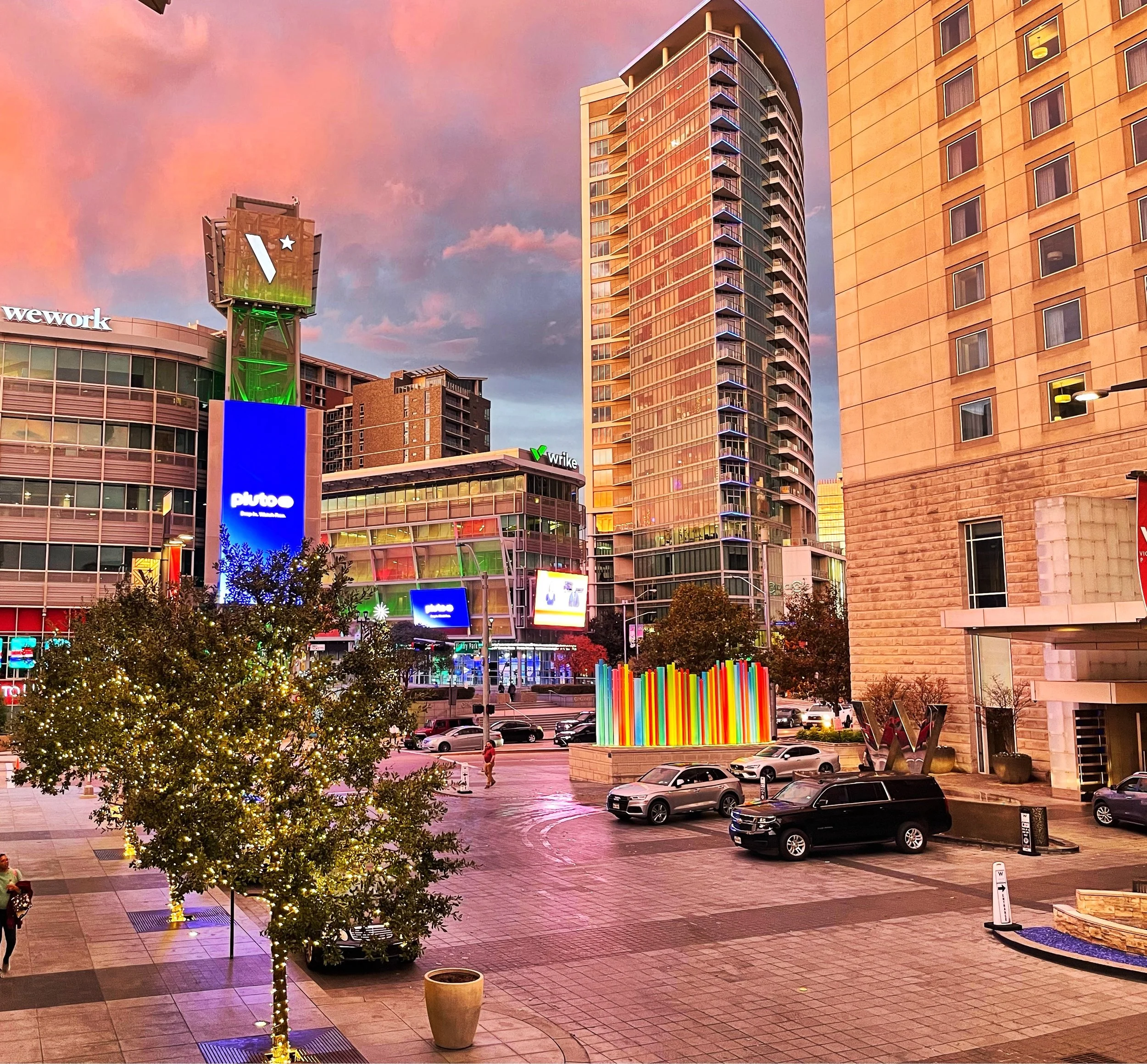
My friend Mendy introduced me with those words at the 2008 Oklahoma Public Health Association (OPHA) Annual Meeting.
At the time, Mendy was the President of OPHA. She had invited my best friend to give the keynote address at the annual meeting, which was held in Tulsa, Oklahoma, in March 2008.
I had moved to Dallas two months earlier. Mendy asked me to return to Oklahoma to introduce Carolyn at the meeting, and I agreed.
After Mendy spoke the words in the title of this post, I stepped to the microphone and said, “I will never be a Texan.”
Never say never!
It’s been 14 years since I accepted a position in Dallas, headed south, signed a lease on the first of several apartments, and purchased a blow-up bed, two wine glasses, corkscrew, and freestanding fireplace during my first month in the Lone Star State.
The truth is that I was probably a Texan the minute my car crossed the Red River, but I was still trying to placate the culture of the state I was leaving – don’t ask why, just hate Texas.
I’ve devoted a considerable amount of space in my blog about my love affair with Dallas, and by extension, Texas. I love the access it provides to things I want to do, its skyline, culture, art, food, and people. I love the freedom it has given me to grow and be the person I always wanted to be. I love the state of mind I feel when I’m in Dallas or Austin or Fort Worth or San Antonio or many other Texas cities.
Before I lived in Dallas, I always dreaded returning “home” after a trip. I used to think it was because of my insatiable wanderlust. Not anymore. I still love to travel, but for the past 14 years, I’ve also loved coming home to Dallas.
I’ve long heard the saying that “home is where your heart is,” the place for which you feel the deepest affection, no matter where you are.
For me, that is Dallas.
Regardless of where I am, I will always be @shellindallas “searching for moments of awe in 2-1-4 and beyond.”
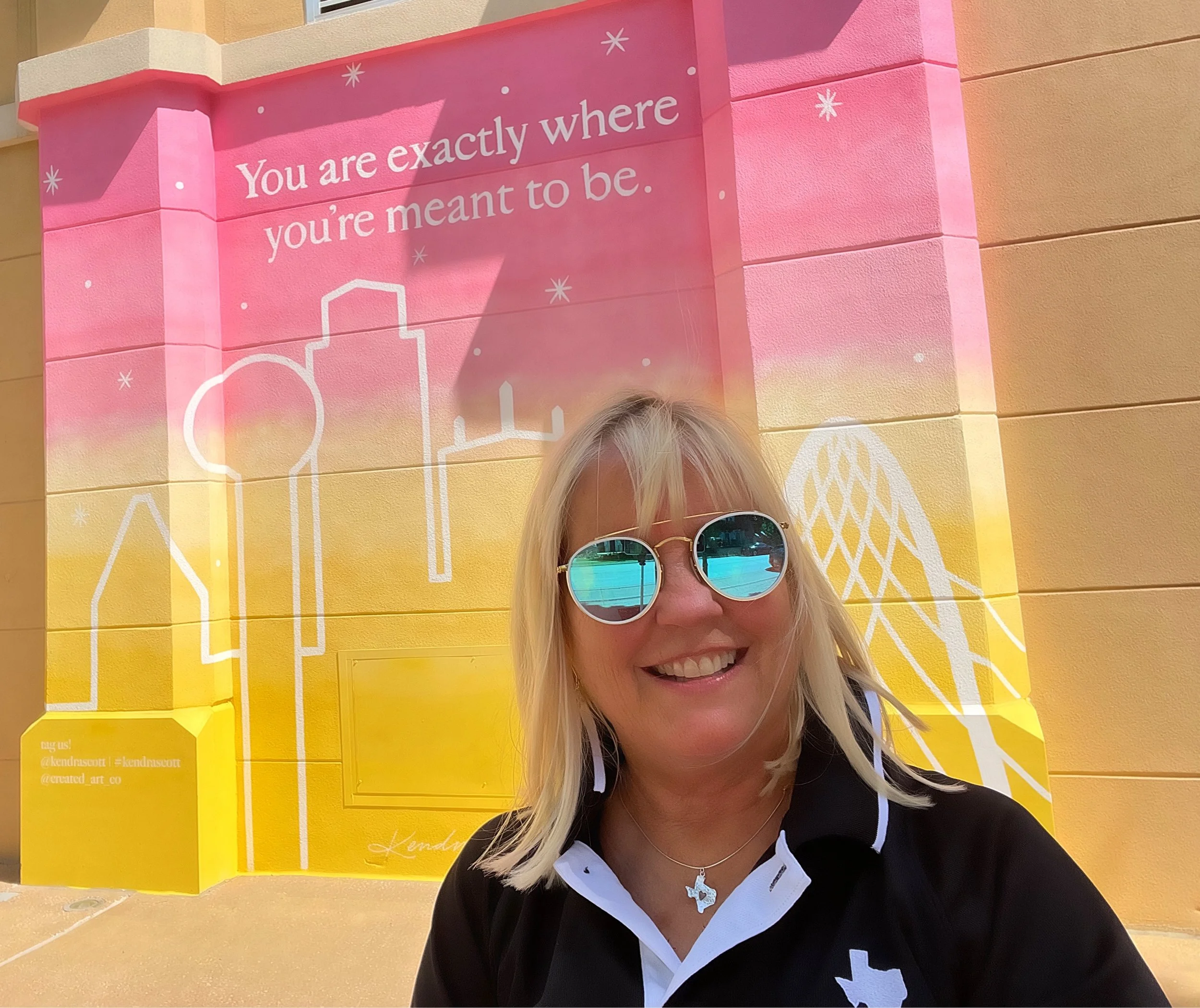
Austin

On Thursday, November 18, I waited outside my apartment at 4 a.m. for my Lyft to arrive and take me to Love Field for a 6 a.m. flight. I had only managed about 3 hours of sleep the night before, but I felt giddy!
I was headed to Austin.
My first trip to Austin which involved more than crawling along I-35 in traffic as we passed the city on our way from Oklahoma to San Antonio was for a conference in 2006. On that trip, we visited mostly chain restaurants outside of the downtown area. We did make it to 6th Street one night, but again, our one bar stop was at Coyote Ugly, a national chain. Suffice it to say, I didn’t really experience Austin on that trip.
Two years later, I was living in Dallas and planning a business trip to Austin. As my plans were coming together, my new (at that time) friend, Paula, an Austinite, invited me to hang out with her when I arrived. She promised to show me her “funky Austin.” My immediate reaction to her comment was that someone I had only had a few conversations with understood me better than people who had known me for years!
It was on that trip that I fell in love with the Texas Capital City.

That love deepened when my friend Stewart moved to Austin in 2011. Stewart’s first professional career was in hospitality, so he set about discovering and sharing all the nuances of Austin that has made it the fastest growing large metropolitan city in the United States, according to statistics released in May 2021 by the U.S. Census Bureau.
Since 2010, the Austin metropolitan area has experienced a 34% population growth, averaging 184 new residents every day.
It’s no surprise that major companies are flocking from Silicon Valley to central Texas. Texas has lower taxes, fewer business regulations, lower cost of living (for now), and more open space to expand. Of course, the result of the explosive population growth means the cost of living is increasing. Housing costs have skyrocketed during the time I’ve lived in Texas.

I saw several t-shirts in Austin on this trip that said, “Don’t California my Texas.” Mostly the people I’ve heard complaining about the explosive population growth are people who have moved to Austin themselves or had family members move to the city. They are complaining about new people relocating to Austin while ignoring the fact that they have also contributed the rising costs.
Austin is far from perfect. Austin and Travis County infrastructure have not kept pace with the growth. The homeless population is escalating. The natural resources that have made Austin attractive are being consumed. And the traffic.
But the Austin that I fell in love with in 2008 still exists. Every trip I make to the city is better than the last. It holds so many memories of times spent with people I love while we listened to live music, experimented with new cocktail creations at speakeasys, consumed amazing food at the local restaurants and food trucks, strolled through the streets photographing the murals, peering over the Congress Avenue bridge to watch the kayakers and bats, and just enjoying being in each other’s company.
That last thought has caused me to ponder – is it the place or the people that make the experience spectacular?
All that I know is that Austin holds both for me. For as long as I am able, I will return often to this city to spend time with these friends while we frequent old haunts and discover new ones.
#grateful4atx

Searching for Hope and Justice

I woke this morning feeling happy.
I arrived in Austin yesterday, a city that I love. I’m in the city for meetings, but I’m getting to spend time with friends I love. The day held a lot of promise.
But now I feel sick.
The verdict in the Kyle Rittenhouse murder case was announced today. Not guilty on all charges.
I admit that I didn’t watch or follow the trial. I feared my stomach and heart couldn’t take it. But here is what I know about the circumstances that led up to the trial. This information is gathered from multiple sources.
On August 23, 2020, Jacob Blake, a 29-year-old Black man, was shot seven times in the back by a white police officer in Kenosha, Wisconsin; Blake was left partially paralyzed.
People protesting yet another shooting of a Black person by police descended into Kenosha in the days following the shooting, as did militia groups, who posted on social media, “Any patriots willing to take up arms and defend City tonight from the evil thugs?"
For several nights, there was protesting in the streets; several businesses were burned.
Rittenhouse, who had dropped out of high school, was 17 years old at the time and an Illinois resident, arrived in Kenosha to “protect people” according to a video interview with him. He had attempted to join the Marine Corps in January 2020 but was disqualified from serving. He routinely posted pictures of himself with guns on social media, including photos with the phrase “Blue Lives Matter.”
Several sources said he idolized police officers and considered law enforcement officers as “his personal heroes.”
Rittenhouse told The Washington Post that he received his first coronavirus check for $1,200. He gave the money to his friend, Dominick Black to purchase an AR-15 style rifle for him. Rittenhouse could not purchase the semiautomatic rifle because he was underage at the time. There are multiple videos of Rittenhouse on August 25 carrying the gun on the streets of Kenosha.
Before the night was over, Rittenhouse had killed Joseph Rosenbaum, 36, and Anthony Huber, 26, and injured Gaige Grosskreutz, then 26.
On the day of his arraignment, he was photographed at a bar in Wisconsin wearing a t-shirt that said, “Free as F--k,” while also making a hand sign that is the symbol of white supremacists. He was served alcoholic drinks, which 18-year-olds can legally consume in Wisconsin. He was serenaded with the song that has been deemed the anthem of The Proud Boys, a group associated with white supremacy.
An investigative article by The New Yorker described a deeply dysfunctional family situation for Rittenhouse. Based on the reporting, it is inevitable that Rittenhouse experienced multiple Adverse Childhood Experiences (ACEs), which have been shown to negatively impact individuals, including increasing the risk for violence victimization and perpetration.
Rittenhouse was acquitted by a jury, a system that was established to protect and ensure that every person who is charged with a crime has an opportunity for a fair trial.
According to the American Bar Association, “The right to a trial by a jury of one’s peers is a cornerstone of American democracy. By entrusting jurors from the community to decide legal cases—some of them involving millions of dollars or life-and-death issues—we reinforce our belief that everyday people can make the right decision, and that we are an open, democratic government.”
Sounds good on paper. However, decades (maybe centuries) of documented unfairness in our justice system have proven that people of color aren’t afforded the same.
The judge in the Rittenhouse case was a 75-year-old white man who is the longest serving circuit judge in Wisconsin.
Judges have the power to determine what evidence and words can be used in a trial. The judge ruled that prosecutors could not refer to the individuals that Rittenhouse shot as “victims.” However, he did allow defense attorneys to refer to Rittenhouse’s victims as arsonists and looters.
Of the selected 12 jurors and eight alternates, there were nine men and 11 women. There was only one person of color. It is unclear as to whether the person of color was seated on the jury or served as an alternate.
The defense attorneys argued that Rittenhouse feared for his life and shot his victims in “self-defense,” which he repeated during his own testimony.
At this time, there is no verdict in another high-profile trial – this one for Gregory McMichael, 65, and his son Travis, 35, who shot Ahmaud Arbery on February 23, 2020, while their neighbor, William "Roddie" Bryan, 52, filmed the murder. The McMichaels claimed they were trying to make a “citizen’s arrest.”
Arbery was unarmed and jogging in McMichaels’s neigborhood. The McMichaels armed themselves with a pistol and shotgun and pursued Arbery in their pickup, ultimately shooting and killing him. The McMichaels said that Arbery “resembled a suspect in “a series of break-ins,” although there are no police reports filed on alleged break-ins.
What is it that makes white men feel the need to become vigilantes? What is it that makes a 17-year-old a cold-blooded killer? What is the reason that causes conservatives and evangelicals praise these murderers as heroes? What is it that makes white women feel the need to call the police on Black men they encounter?
Is it fear?
Or is it a failure of media, our education, religious, justice, and public safety systems?
I don’t know, but I suspect it is all the above. I just know that I’m scared to death of the Kyle Rittenhouses of the world and all the misguided vigilantes that have self-anointed themselves to maintain the pervasive and racist justice of this country’s past.
I’m usually pretty hopeful and optimistic, but today I am sick and scared.
Up and Down

Up and down. It’s a never ending cycle whether you are climbing the ladder of success or slowing down. It’s exhausting and energizing. But, I’m glad to be in this journey called “life.” #stairs #stairsonstairsonstairs #fridaymusings#blackandwhitephotography #morningrun #uptowndallas
Beauty

A few years ago, as a Mother’s Day gift, I invited my mother to accompany me to a fundraiser luncheon in Dallas. The luncheon benefited an organization that I have worked with, and the guest speaker was Maria Shriver, someone that I admire.
Pre-COVID-19, the luncheon was held in one of the ballrooms at the Hilton Anatole Hotel. As we made our way into the ballroom, my mother scanned the surroundings. It was a cavernous space (one of the larger ballrooms in the hotel), and every inch was beautifully decorated, with 2,000+ (mostly women) who were also “beautifully decorated.”
I thought I noticed appreciation for the surroundings in my mother’s face. She is unapologetic about wanting to be surrounded by beauty. At 80+, my mother remains a beautiful woman. Some of it is due to genetics, but she is also vigilant about her appearance and continues to work on her skincare regime. She dresses with a style reminiscent of someone much younger. She maintains a beautiful home and still has a flare for entertaining. When we are together, it is not uncommon for people to comment on her attractiveness. Truth be told, I often feel pride when I hear those comments.
As we were seated at our table at the luncheon, my mother leaned over to me and whispered, “I have never seen so many beautiful women in one place in my life.”
Hearing the comment, I mistakenly thought my mother was referring to the “Dallas image.” Dallas women have long been personified as glamorous and over-the-top with BIG hair, BIG make-up, BIG fashion. I’ve even made jokes about it with my friends.
It wasn’t until several years later that I understood the meaning behind my mother’s comment. We were having a meal at a restaurant in the community where I spent my childhood. I’m usually oblivious to my surroundings, rarely noticing the people in proximity. Perhaps it was because I was out of my element. Or perhaps, it was because I heard someone at a nearby table proclaim their Christian superiority while simultaneously laughing at a disparaging remark about someone else.
The remark caught my attention, and I immediately looked at the man who had said it. He was large, dressed in ill-fitting jeans and a novelty t-shirt and looked unkept. Then I began to observe the other people sitting around us, more notably, their appearance. Everyone, male and female, was dressed similarly.
My immediate reaction was, “Shelli, you’re not in Dallas anymore,” followed by – you guessed it – judgment.
I have a lot of trauma from being in similar conversations with people who have used their Christian beliefs to make hurtful comments about others. So, in a matter of seconds, I went from having a meal with my mother and stepfather to self-righteous indignation, judging everyone in the restaurant by their appearance, and by default, their opinions and worth.
I immediately made a negative comment about how everyone in the restaurant looked. It was then that my mother reminded me of the luncheon in Dallas.
“I enjoy being in a space where others care about their appearance, too,” she said.
I’ve often chastised my mother about her preoccupation with appearance, but on that day, I had to confront my own biased preference for being in the presence of people whose sense of style mirrors my own. I am my mother’s daughter!
Let me be clear – I am not blaming my mother for my shallow thoughts. Mothers, and women in general, are burdened with way too much of the blame for society’s ills. I own every opinion I have – whether it was derived from deep self-awareness or lazy reliance on outdated ideals.

On Sunday morning, I sent a text to my friend Mary Ann who lives in Fort Worth. I was remembering a visit to the Fort Worth Botanic Gardens a few Novembers ago when the Japanese Maple trees were exploding in Fall colors. I asked Mary Ann if she wanted to meet me at the gardens in hopes of re-capturing the beauty in my memories.
I met Mary Ann at a meeting in Austin a few months after I had moved to Dallas in 2008. After spending 20+ years working in a space where I knew multiple people in any meeting I attended, my first meetings in Texas were spent scanning the rooms of unfamiliar faces while trying to find a place to sit. That day, my gaze landed on an attractive woman about my age, who was impeccably dressed. There were plenty of empty chairs in the room when I arrived, yet I chose to sit next to Mary Ann, because she “looked” like someone I wanted to get to know.
While Mary Ann’s appearance may have been the initial reason I chose to sit next to her, it is her intellectual curiosity, quest to be a life-long learner, and gentle grace at steering me away from the judger path that has made us good friends for the past 13 years. Mary Ann is still outwardly beautiful, but her soul is even more so. Mary Ann’s mantra is “speak the truth in love.” I aspire to do that.
I’ve been thinking a lot about the “beauty” expectations that our culture and society has placed on women since I finished Huma Abedin’s memoir, Both/And: A Life in Many Worlds. Abedin, who has worked for Hillary Clinton for 25 years, reminded us that during the 2016 election, Hillary spent the equivalent of 25 days (600 hours) getting her hair and makeup done. She has been criticized for her hairstyles and wardrobe more than her policy ideas, while male public figures have escaped the same criticism. Hillary has said that it takes a lot of effort “just to be a woman in the public eye.”
I think it takes a lot of effort just to be a woman. Period.
From the beginning of my career in 1983 to when I started working remotely in 2020, I spent two hours every day (not just workdays, but EVERY day) showering, blow drying my hair, putting on makeup, and ironing my outfit for the day. That’s 14 hours per week, 728 hours per year, times 37 years. My husband shaves, showers, and puts on the clothes that I ironed for him in less than 30 minutes.
My morning routine is different these days for a variety of reasons. I still shower and blow dry my hair every morning, but my makeup is minimal. My iron is used so infrequently that it now collects dust. And guess what? I now have extra time to do things I really want to do. I’ve been able to fit in more things that benefit my physical and emotional health such as exercise and therapy. I spend more time reading and listening to podcasts. And, I spend more time in meaningful conversations.
These days, I’m also more likely to seek out someone who doesn’t look like me when I enter a room. I’m more likely to sit next to the transgender person, the young woman whose hair color is a rainbow of hues, the young Black man whose hair is a weave of dreadlocks. I enjoy hearing their stories and learning about their experiences.
I’ve also learned that beauty can be both fleeting and ever-present, depending on where you look.

On our visit to the Botanic Gardens, Mary Ann and I discovered that the leaves on the trees had not begun to change yet (this is Texas, not New England). However, the weather was picture perfect, the Koi fish in the ponds were bright and playful, and the street tacos from the food trucks were delicious.
And the day spent with my beautiful friend was just that – beautiful.
As far as my judgmental attitude, well I’m still working on that. I want my behavior to reflect the person I want to be. I don’t want to assume I know the souls of people in Dallas or rural Oklahoma based on their appearance. But I’m probably not there yet.

#stilllearning
#stillgrowing
#stillaworkinprogress
Belonging (Part 2)

I’ve written about the feeling of “belonging” – or not — in the past, but I’ve been thinking more about it lately because of a passing comment my daughter made a few weeks ago. She wondered aloud if she had attended a larger high school if she would have found her “niche” more easily.
My daughter and I are both products of small rural schools where white, evangelical heterosexuality is considered God’s preference . The summer before she entered the 4th grade, my husband accepted a job not far from my hometown, and we moved away from the place where our daughter was born and had attended school since Kindergarten. A place that I had come to think of as “home.”
I did not want to move, but I knew that it meant a new opportunity for my husband’s career. The move came at a time when I was struggling. My father had just been diagnosed with pancreatic cancer. Although the move brought us closer to my hometown and parents, it also felt like a step “back” for me.

I recall attending my first high school football game at the new school. My heart was heavy. Truth be told, I was also angry about the expectations that I “needed to attend” the game when I was dealing with trying to process my feelings about my dad’s health and wanting to be there with him.
As I stood at the back of the end zone far away from anyone in the bleachers, I caught a glimpse of my daughter running by me with a cadre of other 4th graders on her heels. She stopped briefly to wave at me, then proceeded to tell the other kids what they were going to do next. In my mind, I saw the other kids hanging on her every word and following her every direction. And, I said a silent prayer that my 10-year-old had acclimated to her new surroundings so easily.
Twenty-three years later I learned that I had missed major cues that it wasn’t that easy for her. I also learned about her feeling responsible for helping take care of her grandfather and witnessing him in a vulnerable position that haunts her to this day.
I assumed my daughter felt like she “belonged” in her new setting because that’s what I wanted to believe. The truth is that I had spent a large chunk of my life mostly assimilating into the environment although I always had a recurring nagging feeling that I didn’t really “fit.”
I ignored the signs my body was trying to tell me when I was feeling anxious about not “belonging.” I ignored the hurtful comments that made excuses for injustice or worse – laughed at the plight of those who suffered injustice. I ignored the knot in my stomach when I tried to tell someone about my feelings and was dismissed with “I’ll pray for you,” while they moved on to a topic more palatable to them.
I ignored a lot of things in my never-ending struggle to belong in a space where I didn’t fit and was constantly attempting to please and assimilate. I suspect that many of my family members past and present have had the same struggles. I wasted so much time.
I’m happy to report that my daughter and I are both in safe spaces surrounded by people who love us for who we are, not for who they want us to be.
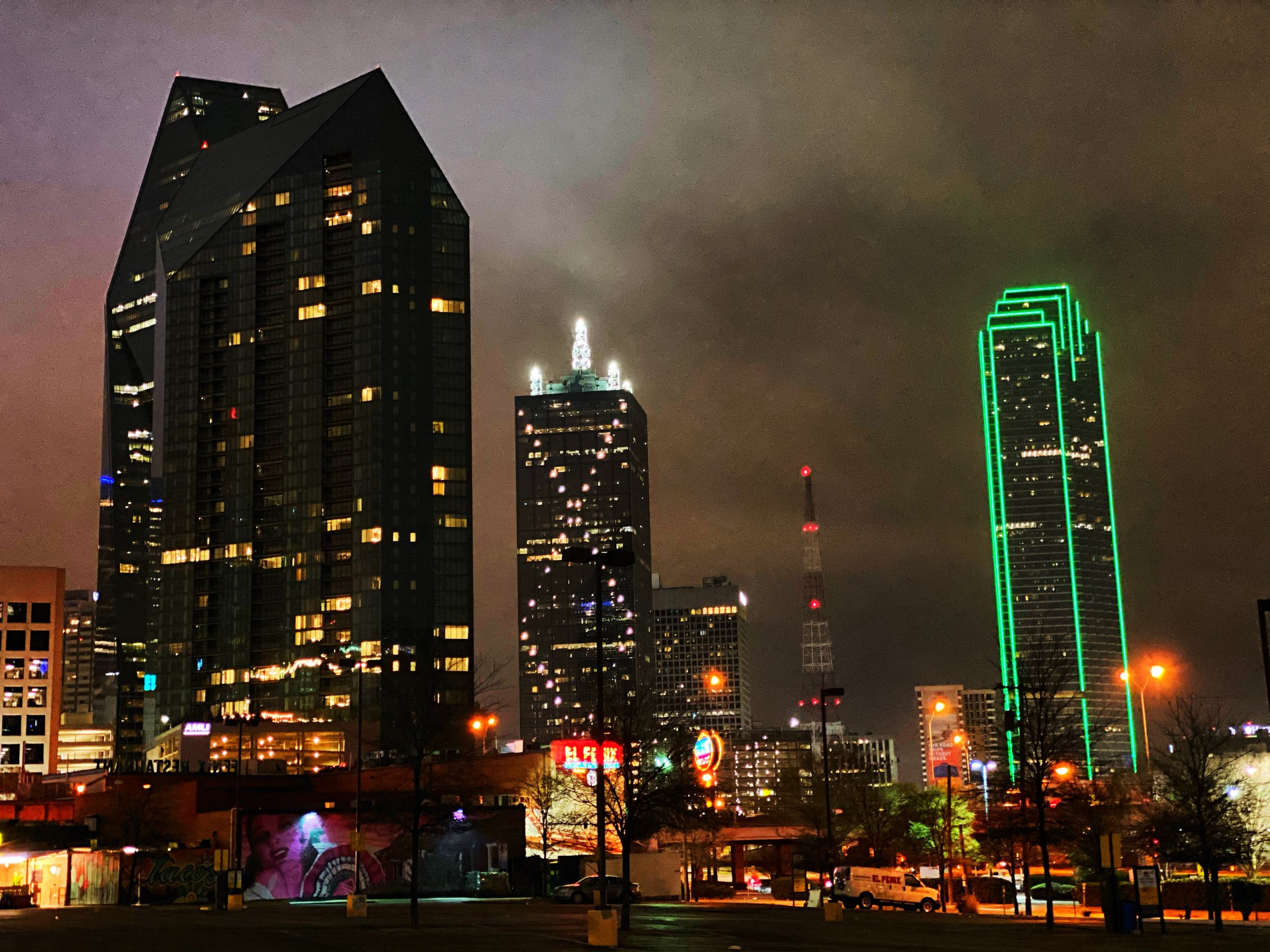
I am forever grateful to the people in “my squad” who have given me the courage to claim who I am without fear of shame or ridicule. My hope is that my granddaughter and younger members of our family find those safe spaces much sooner than I did.
Is Self-Care a Productivity App?

Recently, I did something I’m not accustomed to doing – I spent an entire weekend doing exactly what I wanted to do, which also meant that I didn’t succumb to the expectations or pressure of what others thought I should do.
This is so far from who I am. I have yet to take any of the Enneagram quizzes, but if there is one that is a “pleaser,” it has my name on it. Until recently, I couldn’t even fathom the possibility of saying “no” to a request regardless of how much I didn’t want to do it or how much pain it would cause me. If you have read any of my blog posts prior to 2021, you’ll see just how much I sucked at self-care.
There have been times in the past when I was so miserable, exhausted, and burned out that I’ve broken down into tears during a conversation with someone who bragged about sitting on the deck while leisurely sipping a cup of coffee and listening to the birds sing. For the record, it was a white woman who didn’t work outside the home and talked about how busy she was with her social obligations. As you can see from that last comment, I still harbor too much judgement.
Many years ago, while waiting to pick up my daughter from dance class, I overheard a conversation between several other mothers. One of the moms, who also did not work outside the home, was complaining about how “stressed” she was because she was remodeling her kitchen. I literally overheard her say, “Picking a stain color for my cabinets is so nerve-wracking.” I know that I probably sighed heavily and rolled my eyes. I’m not good at hiding my feelings of disgust, and that has been my knee-jerk reaction far too many times to count.
I mention all of this because I’ve also been doing a lot of self-awareness work on myself, which includes examining my own mental models – in this case, my mental models around work and what I deem as laziness. For those not fluent in systems approaches, Carolina Bento in an article published on December 3, 2017 described mental models as “our own, personalized, self-crafted mental blueprint of how the world works.” They are simplifications and assumptions we have accumulated through a variety of sources including lived experience, culture, society, and academic learning. Our mental models are so much a part of us that we don't have to devote much energy retrieving that knowledge. For those who want to do a deeper dive on mental models, The Systems Thinker is an excellent source of information.
My previous mental model around self-care was that people who take time for themselves are selfish and lazy. Self-sacrifice is laudable. Exhaustion is a badge of honor.
Likely that mental model came from others in my family who passed on unspoken “rules” about how I was expected to behave; rules that I didn’t challenge and probably passed on to my daughter. And, it could have come from mental models of my own because I wanted to be so opposite of the women I described earlier.
Wherever they came from, those mental models have not served me well.
This past summer, I re-read Brene Brown’s book The Gifts of Imperfection, and listened to the 6-part podcast she recorded with her sisters, Ashley and Barrett on the Unlocking Us that celebrated the 10th anniversary of the release of the book. Guidepost #7 in the book is “Cultivating Play and Rest: Letting Go of Exhaustion as a Status Symbol and Productivity as Self-Worth.” Re-reading that chapter and listening to the podcast was painful because I recognized myself. In. Every. Word. I had to confront how much damage I’ve not only done to my own mental and physical health, but also the harmful image I created for my daughter. But it also forced me to dig deeper and challenge my mental model about rest and self-care.
On another Brene Brown podcast – this one with Charles Duhigg on the Dare to Lead platform, Duhigg said, “Throughout history, there’s only been one killer productivity app, and it is, thinking more deeply, training ourselves to think more deeply about the choices that we are making, to make sure that what I am doing right now, aligns with what I think is most important, and acknowledging that it might be different yesterday and it might be different tomorrow, but at least right now, I’m thinking about that and I’m making a choice to get closer to it.”
During my 30+ year professional career, it has only been recently that I’ve been encouraged to “think deeply as a productivity tool.” What a novel concept! However, the reality is that I can’t “think deeply” when I’m stressed and exhausted. There is plenty of credible research on this topic that shows no one can.
There was a time in my not so distant past when my leadership invested a considerable amount of money to train senior leaders in Six Sigma, a highly touted methodology to improve processes. I have not been through the Six Sigma certification course, so I’m not comfortable speaking to whether it is effective. If your job is to make as many widgets as possible, then the Six Sigma methodology may be useful. However, in my profession, building relationships is key, and the focus on Six Sigma felt like leadership was prioritizing “efficiency” over quality.
For the past year, I’ve been in a work environment that prioritizes creating safe spaces for difficult conversations and self-care for employees. As a result, I’ve taken the opportunity to slow down on weekends, ask for what I need, and set boundaries in my personal life. I believe that it has deepened my capacity to “think deeply.”
A final point I want to make is that my ideas about self-care may differ from others. It is not helpful for people to try to tell me (or anyone else) how to rest and relax. I love to travel, but I want to travel to places I want to see with people I want to spend time with doing the things we enjoy. Even if I’m not traveling, the same goes for how I spend my weekends.
And, taking a nap is off the table, unless I’m sick. I loathe naps.
The bottom line is, let’s stop trying to tell others how to think, what to do, and how to relax. We may have common likes and dislikes, but we are also individuals with different likes and dislikes.
Let’s try to be understanding and compassionate. That may be the most helpful thing we can do.
Take care everyone.
Regrets (or Not)?

“It is not the things we do in life that we regret on our death bed. It is the things we do not.”
Randy Pausch
On my last visit to Oklahoma, I noticed the stack of clippings my husband had left for me on the dresser in our bedroom. My mother-in-law has a habit of cutting clippings from the newspaper that she wants us to read, and my husband has adopted this habit. The clipping on the top of the stack on my recent visit was a column written by Dave Ramsey, a personal finance expert, author, and radio host. It was about how individuals should “work first, play later,” a recurring theme of Ramsey and my husband.
Let me be clear – I have no problem with establishing financial security, saving for retirement, or spending money judiciously, even though my husband refuses to give me due credit for that. Even when financial advisors have praised me for my savings and projected retirement income, it is never enough for my husband, but that’s for another blog post.
Ironically, shortly after reading the Ramsey column, I read another article – this one written by Brooke Meredith and published online in Medium on July 8, 2021, entitled, “10 Things You’ll Regret When You’re Older, if you Aren’t Careful.” In this article, Meredith, lays out 10 regretful things, including following the crowd to fit in (#1), not taking chances (#2), and staying in your bubble (#4). But it was items #9 and #10 that caught my attention because they appeared to be in direct opposition to the Ramsey article. Number 9 was not playing more, and #10 was working too much.
I know there must be a happy medium between both philosophies, and that I’m probably not the best persons to blog about this. At 60+ years of age with a healthy projected retirement income, I’m probably not the demographic that Ramsey was talking about in his article. However, it’s something that has been consuming a lot of space in my thoughts. I have friends who didn’t make it to their 60th birthdays. My own father didn’t live to see his granddaughters reach adolescence and will never meet his great-grandchildren.
There’s been a lot of talk lately about the shrinking workforce because of COVID-19, particularly in disciplines of which I’m somewhat familiar. My colleague, Dwayne Smith, public health director of Elbert County Health Department and a 30-year public health professional, recently shared an article from The Gazette, a Colorado Springs newspaper which was published on September 15 and in which he was quoted. The article reported that 40% of Colorado public health leadership have left positions. Yes, you read that correctly – leadership. These are people in leadership positions, and they are leaving because they are being threatened with lawsuits from people with financial resources who disagree with scientific recommendations.
Another article I read recently was written by Jessica Wildfire, entitled, “I’m a Teacher. I’m About to Quit.” In this article, Wildfire, who reports she wanted to be a teacher since she was a child and even obtained a Ph.D., reported that classrooms have become some of the most “dangerous places “ in the U.S. because of “MAGA” students who refuse to debate issues such as abortion and global warming. They are anti-masking and carrying firearms.
Full disclosure: My senior English research paper in 1976 was on abortion. I don’t recall all the criteria for the research paper, but we had to select a topic, research that topic by reading a variety of periodicals on the subject, develop a conclusion, and present the argument for the conclusion based on the research. My conclusion was based on a multitude of mostly medical sources and not consistent with what I had been “told” in church. When I mentioned this to my mother a few months ago, she asked what my English teacher had said when she read my paper. I reminded my mother that my English teacher’s job was to teach me how to gather information, critically evaluate the information, and make informed decisions based on the information. It was NOT to tell me how to think or believe.
I don’t know what my English teacher’s opinion was. She was 60+ when I was in high school and taught in a small school district in Pontotoc County, Oklahoma in 1976, so I can probably guess. She gave me an A on my senior paper, not because she believed my argument, but because she graded me on my ability to consider and articulate the information I had gathered.
I recall having disagreements with my classmates on that topic. However, aside from a few “you’ll rot in hell” comments, I didn’t feel threatened by physical violence because of my viewpoint. I can’t say the same today.
I listen to the stories of my friends in healthcare who are facing a daily barrage of insults and physical violence while putting their own lives at risk to care for patients. Ongoing staff shortages at hospitals are intensifying the problem. I see the exhaustion on their faces. As a friend who loves and cares for them, I am frustrated and my heart aches for them.
The coronavirus pandemic has caused millions to leave the workforce. Some individuals were affected more than others – women (particularly Hispanic women and unpartnered mothers), low-wage workers, young adults, and persons with less education experienced a sharp decrease in employment, according to the Pew Research Center.
But some people (and I acknowledge its mostly white people with privilege, and I am one of them) have witnessed the unpredictability brought on by the pandemic and have chosen to leave unsatisfactory jobs in search of something more meaningful.
My generation was taught to value stability and loyalty. One of the inadvertent things COVID may have done is expose past fallacies. I don’t think stability was ever guaranteed. I’ve watched friends do “everything right” to ensure financial stability only to be ambushed by unpredictable, catastrophic medical bills. I’ve watched friends devote their entire life to a job and then be laid off by corporate America in a “cost saving exercise.”
The people who are making decisions to leave current jobs in hopes of finding something more fulfilling are clearly taking chances (#2 in the Meredith article) in a belief that something better awaits. Only time will tell if that was a good decision.
With the advantage of someone with 60+ years of life experience, I can honestly say that the only regrets that I have are the things I didn’t do – the trips I didn’t take, the questions I didn’t ask, the times I said “no” when I wanted to say “yes.”
I also have the benefit of still being “young” enough to reimagine a different future for me, my daughter, and granddaughter.
There’s a lot that I don’t like about our current reality, but I remain committed to looking at the future through a lens of curiosity and learning rather than blame and judgment and maintaining the status quo.
#continuouslearner #reimagining
Reflections on 20 Years After September 11, 2001

I awoke this morning as I do most Saturday mornings when I’m in Dallas with the sunlight streaming through my windows. I stepped outside my apartment around 9 a.m. CST to a beautiful blue sky and light breezy 70-degree temperatures. Twenty years ago today, people in New York City and Washington, DC awoke to a similar morning (although it was Tuesday), yet by that time in the morning, their lives and our country had forever changed.
On that morning, individuals went to work, took their children to school, boarded planes, and some may have headed out for a long walk just as I did today. What were they thinking before the first plane hit the North Tower of the World Trade Center at 8:46 a.m. ET? What were their emotions before the terror of the day claimed every memory?
As I stepped out of my apartment this morning and breathed in the crisp air, I reflected on my own emotions. If today were my last day on Earth, what would I be feeling on my last minutes and hours?
In my August 12, 2021, blog post, This is Going to Piss Off Some People, I wrote that during 2018 through 2020, I felt compelled to write frequently in this blog because I felt a series of negative emotions. I was sad, angry, confused, and miserable most of the time about the injustices I was witnessing on certainly a daily basis, if not an hourly basis. Writing became cathartic – a way to make sense of my emotions and process my feelings.
But today, September 11, 2021, I feel a very different emotion — gratitude.
Gratitude for the people at the Oklahoma State Department of Health who saw something worthwhile in me and took a chance on a wide-eyed, immature 25-year-old who dreamed of making contributions for a better world.
Gratitude for those who opened new doors for me and pushed me through those doors to new experiences and opportunities.
Gratitude that those new experiences provided me with new perspectives and new friends.
Gratitude that I was in a city that I had never visited with old and new colleagues and friends doing the work that I love on September 11, 2001.

Gratitude that being in Chapel Hill, North Carolina on September 10, 2001, allowed me to meet my forever best friend and share the horror of that day with her, as well as all the conversations and love that have permeated every fiber of my life in the 20 years since.
Gratitude for the path that my life has taken in the past 20 years – living my dream life in Dallas, Texas, and meeting more of “my peeps,” the ones I lovingly refer to as Team Texas!
Gratitude for all the people in my life who accepted the self-righteous, judgmental person I was in my youth and broadened my limited outlook.
Gratitude for the people who have helped me dig deep in self-awareness and reflection and do the laborious work to improve myself so that I can learn from past mistakes.
Gratitude for the staff of the Safe States Alliance who inspire me every day, the long-term members of this amazing association who have given me a second home and family for 25+ years, and the newer members who give me hope.
Gratitude for the roads that lead me on new journeys.
Gratitude that in the midst of a global pandemic, I’m able to see the prospect of a more just world on the horizon for my daughter, granddaughter, nieces and nephews.
I would be remiss if I didn’t acknowledge the gratitude I have for the unearned privilege that has allowed me to never have a door or opportunity closed to me, but to walk from one continuous open door to another one.
I am grateful for a career that has afforded me the opportunity to engage with insightful thought leaders across this nation.
Yesterday, I had a conversation with a colleague at the National Center for Injury Prevention and Control at the Centers for Disease Control and Prevention. Spoken like a true public health professional, he said, “Hate is a contagion. We need to eliminate hate.”
I couldn’t agree more, Neil. Instead of spreading disease, I wish we could spread love and gratitude.
To all the people who lost loved ones and to those whose lives were forever changed on September 11, 2001, I pray that you feel peace.
#neverforget

No Excuses: We Need Better Communication and Discernment Skills

In 2008, I listened to Dan Heath deliver the opening plenary keynote at the Safe States Annual Conference. Heath and his brother, Chip, had released their book, Made to Stick, a year earlier, and the Safe States Alliance had managed to secure Dan at a greatly reduced cost for our 2008 keynote. I recall Dan quoting Mark Twain who supposedly said, “A lie can get halfway around the world before the truth can even get its boots on.” Dan went on to explain that urban legends and conspiracy theories circulate effortlessly, while important information from public health professionals languish. The reason – public health doesn’t know how to create “sticky” messages.
To prove his point, Dan showed a slide from a commercial advertisement followed by a typical slide from a Centers for Disease Control and Prevention (CDC) presentation. The advertisement was flashy, bold, and memorable. The CDC slide was boring, chock full of data, percentages, and graphs. I remember silently scolding myself for not thinking of this earlier because I had received an undergraduate degree in journalism. I knew this stuff; why hadn’t I used my journalism knowledge when I entered the public health field?
I left the conference emboldened to communicate my important messages more effectively. But once I was back at work surrounded by my hospital and public health colleagues, I fell into the same patterns, convinced that our data and graphs were compelling enough to convince the public to wear their seat belts, bicycle and motorcycle helmets, install smoke detectors in their houses, or increase any number of other safety measures.
At various times during the past 13 years, I’ve heard similar presentations by communications specialists at several other conferences, and yet I have struggled to get beyond the theoretical and put into practice what I had learned and implement effective messaging. Why? Possibly it is because I haven’t looked beyond my own public health mental models to understand that not everyone sees the world as a rational public health professional.
Recently, I re-watched the HBO documentary, The Inventor, about the rise and fall of Elizabeth Holmes and Theranos, the multibillion-dollar diagnostics company she founded at 19 years of age. For those who don’t know the story, it is worth reading John Carreyrou’s book, Bad Blood, and watching the HBO documentary. In summary, Holmes was a charismatic, intelligent young white woman who had proclaimed at the age of 7 years that she wanted to be a billionaire. By the time she was 19 years of age, she had a bold vision to develop a small machine that could perform the range of blood tests (200+) with a small finger prick of blood as opposed to the standard venous blood draw in the arm to obtain the necessary vials for standard blood tests.
She ignored the expert advice of medical professionals who told her it was impossible. She obtained a patent and started the company, then she dropped out of Stanford University. She convinced several powerful white men from politics and the military such as George Schultz, former Secretary of State for Ronald Reagan; Henry Kissinger, former Secretary of State for Richard Nixon; William Perry, former Secretary of Defense for Bill Clinton; James Mattis, a retired U.S. Marine Corps general who went on to serve as Donald Trump's Secretary of Defense, among others to serve on her Board of Directors.
She ignored the concerns from the engineers she hired who tried desperately to bring her vision to fruition. She ignored the scientists doing the testing who tried to tell her the machines didn’t work. Instead, she convinced investors like the Walton family of Walmart, Rupert Murdoch, who owns the Wall Street Journal and Fox News, the family of former Secretary of Education for Donald Trump, Betsy DeVos, and others to each invest $100,000,000 or more in Theranos without them ever seeing the equipment or how it worked. Spoiler alert: The equipment didn’t work. After Carreryou’s investigative report exposed the Theranos fraud in the Wall Street Journal, Theranos was dissolved in 2018. Holmes’ trial on fraud charges is expected to begin soon.
One of the whistleblowers who worked at Theranos and reported the fraud is the grandson of George Schultz, yet the elder Schultz continued to believe Holmes over his grandson.
Because I’m trying hard to be in a curious mindset and not in a judgmental one, I’ve been wondering what I can learn from the Theranos story? And no, it’s not that men (aging or otherwise) have a tendency to think with an appendage that hangs below the belt. Instead, maybe it is the same thing I should have learned from Dan Heath in 2008 and the other communications experts in the years following. A compelling story wins the day over data.
Dan Ariely, a behavioral economist who has a doctorate in cognitive psychology and another in business administration, and is the author of Predictably Irrational, appeared in The Inventor. Listening to Airely reminded me that stories sell, and that stories that convey a vision are even more effective, regardless of if they are true or not.
In the documentary Ariely said, “Data just doesn’t sit in our minds as much as stories do.” He went on to say, “Stories have emotions that data doesn’t. And emotions get people to do all kinds of things, good and bad. If you think about the people who invested in her with very little amount of data, it’s about emotional appeal and having trust and believing the story.”
Ariely also said human brains are good at remembering general statements or ideas, but they are not so good at remembering where the information came from, or even if it is true. He said it’s a psychological concept called source monitoring. “When our brain gets a message, we don’t separate very well the statement and where it came from, and we can often get very confused … and not remember,” says Ariely. “It’s why fake news works so well.”
Using just her story, Holmes was able to convince many “strategically brilliant” people to buy into that story.
There’s no doubt that public health professionals need to learn better communication skills and what resonates and what doesn’t. We need to rethink how we communicate.
I recently listened to a video that Dr. Julie Sweetand, a sociolinguist and Senior Advisor at the FrameWorks Institute submitted to my organization, the Safe States Alliance. She said communication should be a core strategy for public health.
I concur. But we also need discernment skills. In addition to telling a good story, we need to be able to determine whether it is true. I’m realizing my own limitations in this as I try to navigate the scores of information about COVID-19 and the variants.
There’s no need to get defensive about our limitations. We’ve all made decisions based on our best available knowledge at the time. I often quote Maya Angelou, who said “Do the best you can until you know better, then when you know better, do better.”
We have all made mistakes. We need to ensure the generations that follow us are taught skills we weren’t and have access to learning opportunities not afforded to us.
It’s time to do better No excuses.

This is Going to Piss Off Some People

When I started this blog in 2018, the intent was to focus on and share moments of awe. After I spent the year before living in a cloud of confusion and despair, my best friend suggested that I direct my thoughts and experiences on finding moments that would bring me joy and fulfillment. Honestly, I agreed to do that because I wasn’t sure that I would survive otherwise. The events of November 2016 and the aftermath had zapped every ounce of resilience and hope from my body.
So, I started “searching for moments of awe.” And to be clear, I had to “search.” Every day brought a new horror to the news cycle, so I had to make a conscious effort to “search.” Because of that effort, I spent a lot time writing in this blog about that search. Consequently, I posted a new blog weekly; sometimes more. I barely took a breath. I was in a constant state of fear, so I was constantly searching for something positive – anything.
From 2018 through November 2020, I posted multiple times a month. Since January 20, 2021, I’ve posted less than two times per month.
What has changed? Is it the constant fear I felt from 2017 through 2020? I’ve certainly felt fearful in 2021. I felt fear and despair on January 6 when I watched on television as a mob carrying weapons and Confederate flags overtook the Capitol in Washington, DC, threatened the lives of our Vice President and members of Congress, tried to stop our democratic process protected by our Constitution, and left a trail of destruction in buildings and a process that I had come to revere.
Honestly, I still feel fear every time I drive past a house displaying a Confederate flag or pass a pickup with one flying from the truck bed with bumper stickers proclaiming hate against members of the Jewish and Black communities (I’ve lost track of how many times this has happened). My hands clench my steering wheel while I say a silent prayer that I don’t have car trouble during those moments.
I certainly feel fearful right now as I watch the latest surge in coronavirus cases due to Delta and other variants. I feel fearful because these variants do exactly what we know and have known they do – they mutate into more efficient and deadly versions when they haven’t been wiped out by vaccines. Even after mandatory science classes in elementary, junior high, and high school, and 16 hours of required science classes for a journalism major in undergraduate school, I am not a virologist or infectious disease expert. However, my career path has provided me access to people who are. I will not try to explain here how viruses mutate because there are many credible sources that can do a much better job. I’m just trying to paint a picture as to why my academic studies and 30+ years as a public health professional have contributed to my trust in science and access to professionals I trust.
In 2020 and 2021, several of my friends and family gave birth to or welcomed infants. Many of them, I have not had the privilege of meeting because of the pandemic, but I love them because I love their parents. I have young nieces and nephews who are not eligible to receive the coronavirus vaccines because of their age. I would do anything to protect these children.
And I became a grandmother in 2021. Recently, my friend Leslea posted on Facebook her heartfelt intention to do anything possible to protect her 1-year-old granddaughter. I can relate.
The actor, Jennifer Aniston recently posted on social media that she has made the decision to cut non-vaccinated people out of her circle, and she received criticism for that decision. Her response was that even though she is fully vaccinated and may get sick from the variant, she could unintentionally pass it on to someone who hasn’t been vaccinated (children less than 12 years) or whose immune system is compromised because of a pre-existing condition (e.g., cancer, multiple sclerosis, diabetes, etc., all of which members of my family have), and therefore, she puts their lives at risk.
I concur.
I don’t care what the people in your Facebook feed, church, or conspiracy theorists say. I will take every precaution to protect the people I love, even if it means not having contact with friends and family members who aren’t vaccinated. I’m back to wearing a mask. I’m back to not congregating indoors. I’m back to limiting the things I love like travel. I’m back to being inconvenienced because of people who refuse to get vaccinated.
And, if you refuse to get vaccinated, I will continue to take precautions and not unintentionally expose you because I care about your health, even if you don’t care about mine or the health of those I love.
On a positive and “moment of awe” note, I’m encouraged by the number of new vaccinations being reported every day.
I still feel fear in 2021, but the difference is that I feel confident that our current administration will shepherd us through the difficult and uncertain times ahead of us. And I wake up every day and say a prayer of gratitude to Jesus, the universe, and the 80 million people who went to the polls in 2020 and cast a ballot for empathy and competency.
Decisions Require a Look Back to Look Forward

I have never been a person that likes looking back; I’m much more into looking forward. Through my “rose-colored view,” I have always believed that the future held opportunity and promise. Even when I left communities and situations that I enjoyed while facing an uncertain future, I have always been more focused on creating a future that was palatable rather than getting stuck in glamorizing and longing for the past. But if therapy has taught me anything, it is that sometimes I need to look back and understand the past before I can move forward.
I’ve been doing that a lot lately because of a question that my sister posed to me a few weeks ago.
“Just what is it about Dallas that you like so much?” she asked.
The question came as I was driving back to Dallas after spending the week in Oklahoma. As Sonya uttered that question, the skyline of Dallas came into view, and I could feel my heart rate slow as it does every single time that I drive or fly into the city that has been my home for the past 13 ½ years.
Sonya’s question is only one of many that I’ve been asked by numerous people who expect me to move back to Oklahoma to be nearer to my granddaughter. I can provide a litany of reasons why I love Dallas, but before I do, it’s worth a trip back down memory lane.
When I look back on my childhood as I played with either my dolls or my male cousins’ Hot Wheels toys, I imagined my future as an adult living in California or Hawaii. At that age, I was enamored with the beach. I still am, possibly because I was born under the Pisces astrological sign. As I grew older, I always dreamed of living somewhere other than Ada, Oklahoma, and truth be known, somewhere other than the state of Oklahoma. Unfortunately, when I graduated from high school, I lacked the courage to venture out on my own and attend an out of state university.
After my husband and I married, he was approached about an opportunity to coach basketball for a year in Great Britain. I salivated at the prospect, but my husband wasn’t interested. After I discovered snow skiing in my 20’s, I started subscribing to The Denver Post, scouring the classifieds every Sunday looking for job opportunities. Again, my husband wasn’t interested in relocating. Because I had a strong desire to stay married to him, I gave up on my dream to move to Colorado.
In 2007, I was offered a position in Dallas. Our daughter was in college, and my husband was eligible for retirement in Oklahoma. After much discussion, we decided that I would accept the job and move to Dallas in January 2008, and that he would join me in May at the end of the school year. He made it very clear that he didn’t want to retire in Dallas (“God never intended for me to die in Texas,” he has frequently said.) We agreed that we would live in Dallas for 10 years and move back to Oklahoma at the end of that time to retire.
As the time neared for my husband to move to Dallas, it became abundantly evident that he didn’t want to move. Everything he enjoyed and loved was in Oklahoma. So, for the past 13 ½ years, he has maintained our house in Oklahoma, and I have lived in Texas.
I have loved every single minute that I’ve lived in Dallas. Even when the dream job I came to Texas for became toxic, I still loved this city and everything it has to offer.
What do I love about my Dallas life? I love that I can finally “practice what I preach.” As an injury prevention professional, I have long wanted to live in an area that prioritizes pedestrian and bicycle transportation and not reliability on motor vehicle travel. I live in an area where my Walk Score is 89. I can walk to any number of retail shops, restaurants, and entertainment establishments. There are multiple grocery stores, including Trader Joe’s and Whole Foods within a 2-mile radius. My dentist’s office is one block away, and my ophthalmologist is within one mile. There are two urgent care clinics within that radius. My church, which is a “transformative Christian community that is inclusive, expansive, and entrepreneurial” is within 1.5 miles. I rarely use my car other than to travel out of town. If I’m not walking, I have access to safe and affordable public transit. It has always been important to me to become less reliant on motor vehicle travel as I age.
I live within five miles of two Level 1 Trauma Centers and cutting-edge health care, something that has also become more important as I age.
The Katy Trail, a safe, well-lighted running trail is steps away from the front door of my apartment. The Dallas Museum of Art, Dallas Holocaust Museum, Nasher Sculpture Garden, as well as a few other private art museums are within that radius. There are several urban parks, complete with food trucks featuring Mexican, Indian, and Ethiopian cuisine, which I love, as well as the standard Texas barbeque, which I have no interest in partaking. There are six Starbucks, and better yet, four local coffee/tea shops within walking distance.
During the COVID-19 pandemic, I went for a walk on the Katy Trail every day, ordered, and picked up meals from any of my neighborhood restaurants, or ordered groceries from Instacart. I never felt deprived; only grateful that I lived in a place that offered those opportunities.
In my 13 ½ years in Dallas, I have yet to overhear anyone in one of my neighborhood restaurants, bars, or coffee shops complain about “foreigners “or “colored people” or even use those ridiculously offensive and outdated terms. I haven’t heard anyone complain about members of the Lesbian, Gay, Bisexual, Transgender, Questioning (LGBTQ) community or Muslims. I have friends of multiple nationalities, religions, sexual orientation, etc. in Dallas and across the U.S. and other countries and continents, and I love every one of them. During my time in Dallas, I have become increasingly intolerant of discrimination and hate.
The reality is that for my entire life, I have longed for the diversity that I had no access to in my childhood, adolescence, and young adulthood. I crave the intellectual growth and discussions that have become paramount in my job, friendships, church, and daily existence.
After I had been in Dallas for 6 months, I started worrying about the fact that I only had 9 ½ years left in Dallas. As much as I enjoyed living here, I couldn’t shake the anxiety that every day, week, and month brought me closer to returning to a location where I didn’t want to be.
Early in the book The Help by Kathryn Stockett, the main character “Skeeter” who spent four years at the University of Mississippi (Ole Miss) has arrived back in her hometown of Jackson, Mississippi after receiving a journalism degree. She has just attended a Bridge card game hosted by her hometown friends. All of Skeeter’s friends left college early sans a degree to return to Jackson and get married. Skeeter is ruminating on comments made by her friends during the card game and thinks to herself that she feels like she has been “dropped in a place where she doesn’t belong anymore.” Her next thought is that she wonders if she ever did belong in that place?
I read The Help in 2009 – a little over a year after I moved to Dallas. When I read that line, instantaneously I thought “that’s it.” That’s exactly how I felt (and still do) every time I cross the Red River to return to Oklahoma.
When I lived in Oklahoma and returned from a vacation or work trip, I always experienced a sense of dread, followed by days of depression. When I return to Dallas after a trip, I feel excitement.
This is not meant to be negative to Oklahoma. I have friends and family whom I love and who are very important to me who live in Oklahoma. They love Oklahoma, and I respect that. My desire to live in Dallas doesn’t mean I don’t want to be with them. It just means that I want something different.
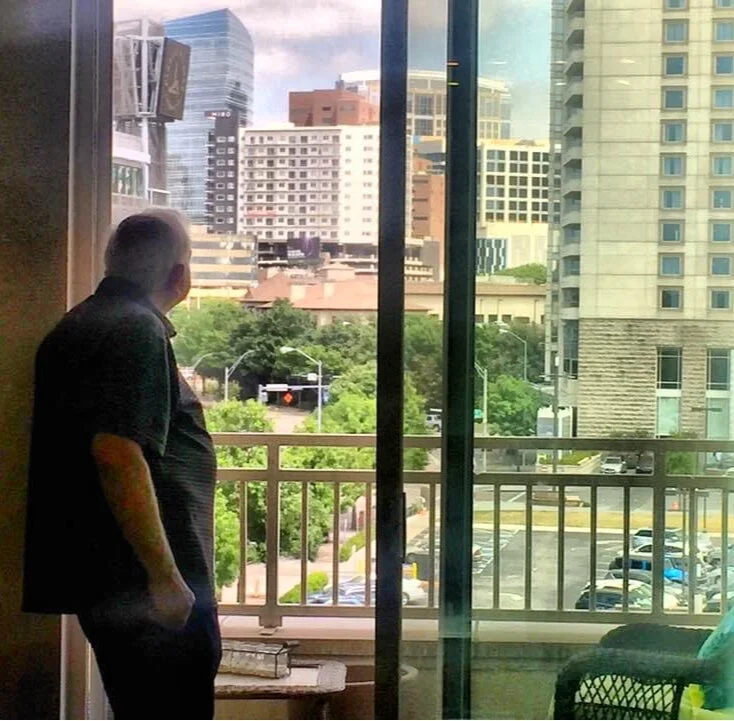
There’s a photo that I took of my stepfather looking out a window in my apartment in Dallas. After I snapped the photo, I asked him what he was thinking about.
“There’s a lot of concrete and people out there,” he replied.
I can only imagine that my stepfather who lived on an Oklahoma farm most of his life, and now loves gazing out from the patio of the house he shares with my mother as the deer and other various forms of wildlife venture in view, shuddered at the prospect of living in Dallas. But I love watching the sunrise and sunset between the high-rise buildings and the energy and everything else Dallas has to offer me, as well the opportunity it has provided for me to live the life I always wanted and imagined.
I think society has instilled in women that they need to “sacrifice” their own desires for those of others. My best friend and I have been talking about core values – those that society has pressured us to adopt versus the ones that we are born with and make up every particle of our DNA (that’s another blog post for another time).
After a lengthy discussion with my therapist, it has become abundantly clear that I spent my entire life prior to 50 years of age wanting to live somewhere other than where I did. I finally got the chance to experience my long-held dream, and I’m finding it extremely difficult to give it up to return to a place where I never really “fit.” For years, I have told my husband that I would move back to Oklahoma and adjust – because that’s what I do, and that is what I have always done. I adjust to fit the needs and wants of others regardless of how I feel about it. I sacrifice my own needs for those of others because that is what culture and society has told me to do.
As another year and decision time looms closer, I am thinking about many things. The unreasonable expectations to shoulder the burdens of the family that are still placed on women – mothers and grandmothers. The dichotomy of living in two worlds that are opposed to each other and how to navigate the divide with understanding and grace. The competency and courage to do what is best for me, because ultimately, that is what is best for my family.
There’s still a lot of work ahead for me. Stay tuned.

Practicing What I Preach

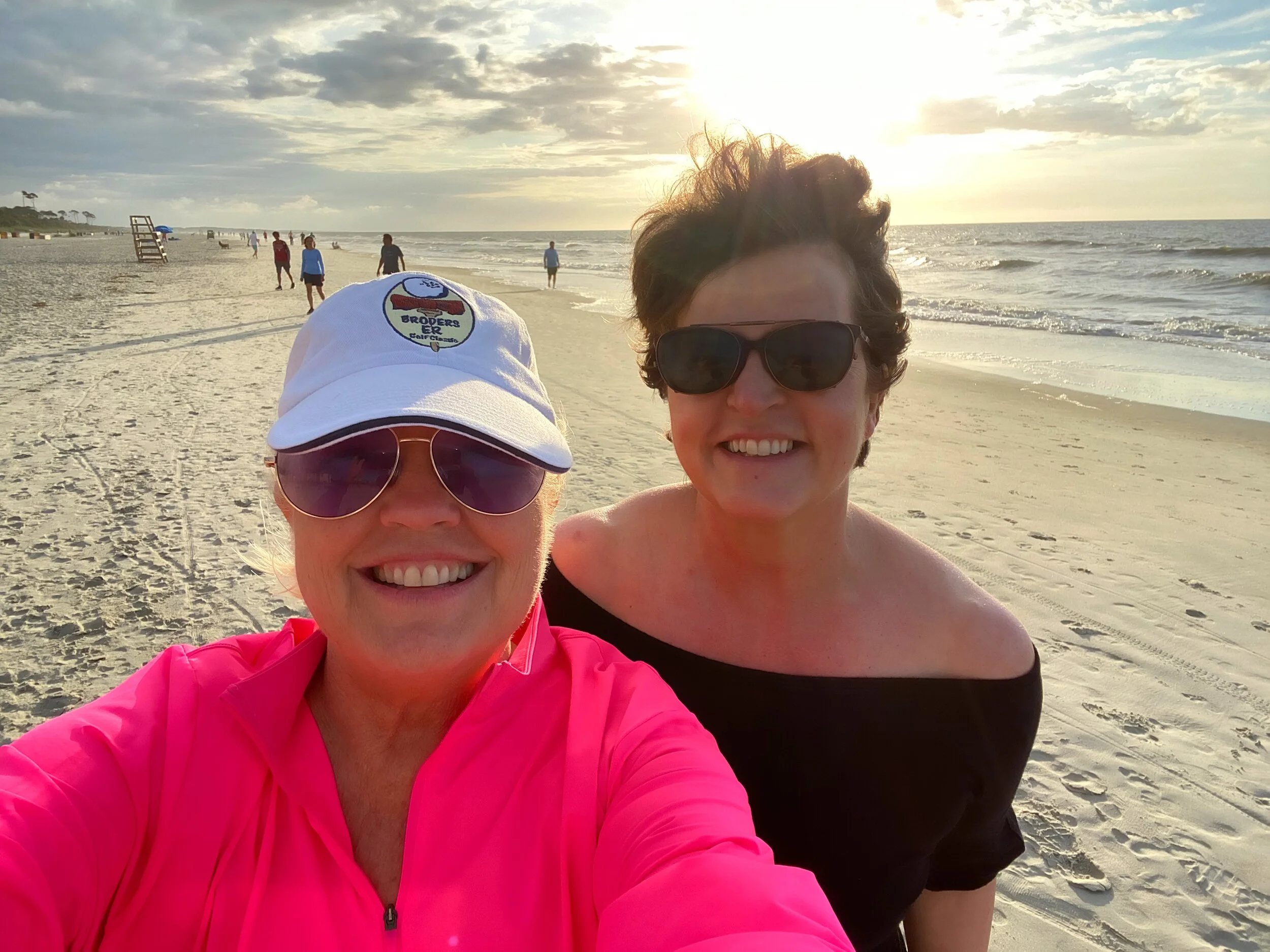
Yesterday was National Best Friends Day. It was also my best friend’s birthday. I last saw her in person, last hugged her and felt her arms around me on March 6, 2020, when she dropped me off at Baltimore Washington International Airport after I had spent the weekend with her family. When she called to inquire if I was interested in meeting her somewhere for her birthday this year, I didn’t think twice. With both of us fully vaccinated, I jumped at the chance to spend time with her. Without much discussion, we decided to fly to South Carolina to repeat a brief trip we attempted to Hilton Head Island in 2007 (that’s another story for another time).
Photos are important to me – always have been and probably always will be. I have hundreds of photos of us together in many places at various times during the past 20 years, including one of us on the beach in Hilton Head at sunrise on the previously mentioned trip.
A few weeks ago, another friend of mine had knee replacement surgery and suffered complications following the surgery and had to be readmitted to the hospital. She shared with me that during one her low points, she realized that she had spent much of her life in a self-critical mode – focused on how her body looked rather than being grateful that it performed as it should. At the time, I thought her words were profound and vowed to do better at self-compassion.
This trip was like many others with me immediately taking photos of the surroundings, including several selfies. But as I looked at each of the selfies, I cringed, and one by one, I deleted them. I was more than a little critical of my image in the photos. The humidity wreaked havoc with my hair. I had gained too many pounds during the pandemic. I looked my age, with the wrinkles and dark circles under my eyes evident.
My best friend said she wanted this trip to be about self-care and self-compassion, something we are both lacking. I had agreed and had every intention of “doing better,” but every good intention I had prior to the trip vanished when I looked at the photos. However, after I had made one too many critical comments on one of our long walks on the beach, long talks on our balcony, and multiple glasses of wine, my brilliant BFF reminded me of the purpose of this trip. And the words of my other very wise friend started ringing in my ears.
So here are several photos of my incredible time with my best friend at a beautiful beach resort as we reconnected while listening to the melodic and calming sounds of the Atlantic Ocean. And there’s even a selfie sans makeup with frizzy hair and extra weight. I’m finally feeling grateful to my body and mind that I could enjoy this special time and another trip around the sun with my BFF.
Happy birthday, CC-F.
Endings and Beginnings

Que sera, sera
Whatever will be, will be
The future's not ours to see
Que sera, sera
What will be, will be
For as long as I can remember, I have heard my mother sing the song that Doris Day introduced in the Alfred Hitchcock film The Man Who Knew Too Much. Full disclosure, I haven’t seen the film (I watched one Hitchcock movie in junior high school and refused to ever watch another horror movie). It wasn’t until recently that I knew the origins of the song – I just knew that it was a song my mother liked.
After my daughter was born, that was the song that my mother sang to her, as she also did with my nieces and great-niece when they were infants. Last week, I heard my mother sing the song again – this time to my granddaughter, and the words took on new meaning for me.
The day after my granddaughter’s birth as I was marveling at photos of her with a sense of hopefulness for her future, it was announced that Bill and Melinda Gates, co-founders of the Bill and Melinda Gates Foundation, were divorcing after 27 years of marriage.
Obviously, I don’t know the couple, but I have followed their philanthropic work, read their books, and watched interviews with them. From an outside perspective, their marriage, parenting, and work seemed to be an equal partnership, which is something that I admire. So, I was surprised and disappointed to hear they were divorcing.
For most of my life, I believed that only two things could end a relationship or marriage – infidelity or physical abuse. One of my favorite movies of all time is The Way We Were with Barbra Streisand and Robert Redford. When I watched it onscreen for the first time when I was 16-years-old, it was unfathomable to me that two people who were so clearly in love wouldn’t/couldn’t stay together. Forty-seven years later with the benefit of life experience and a little more emotional maturity, it is no longer a mystery to me.
I have many friends who have divorced or separated because they married or partnered with a person of disparate religious, political, economic, life, values, or familial convictions. Some have weathered the separation with grace; others have not.
We’ve been led to believe that love conquers all. Our churches, media, families, and culture have taught us this. But sometimes it doesn’t. Sometimes love just isn’t enough.
When I watched the The Way We Were, I cried because I was sad and didn’t understand. When I watched Episode 8 of Season 6 of Schitt’s Creek (yes, I’m still on a Schitt’s Creek binge), I cried because I understood. I have learned that you can hold two competing ideas and feelings at the same time. It is possible to love someone with all your heart and soul and not be able to live with them. It is possible to care about someone and need to set boundaries around a toxic relationship.
As with any high-profile divorce, there has been speculation as to the reason why the Gates have decided to end their marriage. Honestly, I don’t care. I’m not interested in the solacious gossip about the Gates’ marriage. But I am saddened by the fact that a union that began with hope and promise has ended.
I don’t know what my granddaughter’s future holds. Honestly, I don’t know what my own future will be. But a lot of therapy and a continuous journey for emotional maturity has prepared me for the unknown and uncertainty. The one thing that I am certain about is that there will be storms. I’m hoping that my granddaughter, my daughter, my family, my friends, and our society will have the competency and bandwidth to navigate them.
Dear Zola

Dear Zola,
I love you. You have captured my heart in ways no words can describe.
I thought I loved you 8 ½ months ago when your mother told me you were on the way. Then, I saw an ultrasound photo, and I loved you even more. When your mother sent another ultrasound photo 3 months later with a text that said, “It’s a girl,” my heart ballooned.
A global pandemic has kept me away from your mother for most of her pregnancy – something for which she may be grateful, but it has been torturous for me (you’ll understand some day)! I had to watch you gradually grow in her belly with the help of Zoom and FaceTime calls. I will always be thankful for technology during this time.
I kept thinking you would arrive early like your mother, but you, Zola, decided to wait until after your due date to make an appearance. I expect that patience is just one of the many things you’ll be teaching me in the future.
I drove to Oklahoma from Dallas on April 28 because I thought your mother’s water had broken. I was so distracted thinking that you were arriving soon, that I forgot to wish Sonz and Scott a happy anniversary. It may have been the hardest lesson in trust that I’ve ever experienced, as we waited for several days for word from the doctor that it really was time for your mother to go to the hospital. I slept with my phone on the bed beside my pillow Wednesday, Thursday, and Friday nights waiting for a call or text.
By Saturday, I was convinced you wouldn’t arrive until Monday, your mother’s scheduled induction date. So, I placed my phone on the nightstand, a whole foot away from my head. Maybe it was the fact that I hadn’t slept more than a couple of hours the nights before, but I managed to miss the texts from your mom and Sonz. How is that even possible? I was in the hospital waiting room for every agonizing second of Madi’s labor with your cousin, Audrey, yet I missed multiple texts and calls from your mom and dad and Sonz on Saturday night telling me that you were about to make your entrance.
When I finally looked at my phone at 8:23 a.m., I saw the last text from Sonz that said, “Don’t you want to hold that little bundle?” One of many regrets is that I missed all those texts and calls, but that regret pales in comparison to the gratitude that I feel for Sonz, McKenna, and Madi for talking and texting your mom through contractions throughout the night!
Zola, I hope that your life will be consumed by gratitude and wonder and not regret.
A few months ago, I read Our Italian Summer, after my best friend Carolyn mentioned it to me (I hope you’ll get to meet Carolyn and all my wonderful supportive friends soon)! The story is about a teenager (Allegra) accompanying her mother (Francesca) and grandmother (Sophia) on a trip to Italy. I’ll skip all the details because you may want to read it someday, but there is a part in the book where Allegra is complaining about her mother to her grandmother (yes, this may occur in your future, too, and I’ll be there to listen).
After she listened to her granddaughter, the grandmother said, “Mothers will never be perfect. We make many, many mistakes. The only thing we can hope is for our children to forgive us and believe we did our best. We must forgive our mothers for everything they are not.”
Zola, your parents may not always parent you in the way that you need or want, but I hope that you will always feel their love.
When your great-grandmother Emmy saw your photo today, she sent a text that said, “What a beautiful new person to love.”
So true! You are surrounded by many people who love you, Zola – your family and the extended family of all our friends. We are so glad that you are finally here.
I can’t wait for our adventures to begin! I can’t wait to discover who you are and who you will become. But I will. I will do my best to be patient. I will do my best to make sure you get to be you, whoever that is.
Love,
Nonni
Lightening in a Bottle

On a lark on a Saturday in late March in 2012, my friend Gail and I decided to get in the car and drive to Ennis and follow the Bluebonnet Trail in search of bluebonnet photos. Neither of us were Texas natives, but both of us had been living in Dallas for a few years. With me driving and Gail navigating the Bluebonnet Trail map on her phone, we progressed through the Ennis Bluebonnet Trail, with each mile unveiling an even more spectacular rolling pasture thick with bluebonnets. That day, we experienced “lightening in a bottle,” with possibly the best bluebonnet season in Texas in years. I took some of my favorite bluebonnet photos that day.

Every year since then, I have driven back to Ennis around the same time of year, following the same path, and I have yet to see the same lush bluebonnet fields or capture similar photos. When we are lucky enough to experience “lightening in a bottle,” we often spend our time with tunnel vision chasing the perfection of the same dream. In doing so, we may miss new opportunities and new experiences.

During bluebonnet season this year, I’ve made three trips to Ennis – partly because I’m still feeling claustrophobic from 2020 and 2021. Two of those trips, I followed the same route as I had in the past. However, on the third trip, I ventured off the trail. While I didn’t see the lushness of 2012, I was able to capture new sites that brought “moments of awe.”

Languishing

This week, I read Adam Grant’s article in the NYT about “languishing.” It described my feelings perfectly. Languishing between what was and what is ahead.
Perhaps my mood is because I didn’t even see much of my own city this week because news of more mass shootings, including in my own state sent me over the edge, so I stayed home. No morning runs, which I have started to love. I looked out on my city from behind the treadmill. I’ve been thinking about past travel. I’ve been thinking about travel planned with friends this year. I’ve been thinking about all of the wonderful things in my future, but I don’t know when it will happen. So, I’m languishing in a meh mood.
One of the very important things I’ve learned in the past few years is to recognize those feelings. Don’t push them away or ignore them. Denial doesn’t mean they don’t exist. I will own my feelings while continuing to seek joy until “what’s next comes.”
#languishing #postcovid19 #whatsnext #100dayproject2021 #dallastexas #nyc #fridaythoughts
Multiple Perspectives

I spent my entire childhood, adolescence, and most all of my adulthood being told and believing that there is a right way and a wrong way, that clarity is the goal, uncertainty is problematic, and that anything contrary to that is blasphemous. To be honest, those “truths” have not served me well, and for the longest time, left me ill-equipped to understand complexity, much less navigate it.
A few years ago, I was introduced to Bill Torbert’s work on collaborative action inquiry by some colleagues who were recommending it be used to improve and transform injury and violence prevention through a systems approach. When they approached me about joining an action inquiry group that would meet monthly, I was simultaneously intrigued and wary. I was intrigued because there is nothing that gets my juices flowing more than thoughtful intellectual conversations with emotionally intelligent people about complex problems. I was wary because I knew that the practice would require considerable self-reflection and multiple levels of awareness. Although I have gotten better at being self-reflective and thinking beyond first person awareness, I was initially fearful of those practices. I don’t like to feel uncomfortable or vulnerable (see first paragraph). So, it was with some hesitancy that I agreed to join the group.
I am grateful for that decision daily. This inquiry practice has helped me resolve the discomfort and confusion I feel around cognitive dissonance. I know now that it is possible to hold multiple conflicting perspectives at the same time. And, I had several opportunities to notice that happening this past week.
I watched the accolades roll in for Prince Philip following his death. He was praised for his service to the British Royal Navy, his long marriage to Queen Elizabeth, and his contributions to the British monarchy. For obvious reasons I have a hard time heaping praise on a 99-year-old white man born into Greek and Danish royalty, who then married into British royalty, and whose racially insensitive comments were often coded as “gaffes.” However, by all indications, his grandchildren appeared to have much affection for him, so I felt compassion for their loss.
When listening to another podcast about the Tulsa race massacre of 1921, I felt angry at an educational system that has mislead me while also feeling grateful for the income it provided my family.
I seethed at another hateful comment made by an evangelical, while finding sanctuary in my own Christian beliefs.
I felt incensed at Sharon Osborne’s defense of her friend, Piers Morgan, someone I consider an embarrassment to journalism, and then felt defensive when a journalist I respect said something derogatory about someone I care about.
I have fond memories of watching The Little Mermaid dozens of times with my daughter when she was a toddler and now feel irritation with the message of the film that girls can only gain independence from their family and acceptance from a man if they change their appearance and give up their voices.
Shedding the shackles of certainty and embracing uncertainty is hard. But it can also be transformative and freeing. I’m learning that the conflict I have felt around binary thinking is not a problem, but binary thinking is. Life is complex, complicated, and uncertain. Trying to over-simplify complicated feeling and new experiences by putting them into outdated generalizations and stereotypes can move us even farther away from clarity and connection.
I can’t say that I have learned to embrace uncertainty, but I don’t fear it anymore. I can sit with the uncomfortableness of it and be curious about my feelings. For many years, the gravitational pull to certainty hindered my ability to grow. I am happy to be free of those restraints. I am grateful to the people who still provide me with opportunities to learn.
Lessons from Schitt's Creek
I’m late to the game. Last year when virtually everyone in North America turned to binge watching Schitt’s Creek to help them escape from the s**t show that was 2020, I resisted. I knew the storyline – an obnoxiously privileged family who lost their wealth and livelihood and had to move into a motel in a rural town that the father “purchased” as a “joke” birthday gift for his son. It was components of that storyline that formed the basis of my resistance. I’ll try to explain.
First, I’m not really into binge watching. No shade to those who enjoy it, but honestly, the idea of sitting stagnant in front of a screen for hours just doesn’t appeal to me. I would much rather be doing something outside – walking, strolling through my neighborhood, taking photos, etc. That said, I have spent many late nights during the past 4 years when I couldn’t sleep watching and re-watching episodes of The Newsroom, Big Little Lies, Little Fires Everywhere, or some documentary.
That brings me to my second point – I like sharp, intellectual dialogue (hence my preferences listed above). Slap-stick comedy bores me, as does reality television (although I do watch HGTV and the DIY network). I have yet to watch an entire episode of Keeping Up With the Kardashians, the Real Housewives, or anything else on Bravo. Again, no shade to those who do, but it’s just not my taste.
So, I resisted watching Schitt’s Creek. Even when friends whose opinions’ I respect gave it glowing recommendations, I resisted. After all, I know what I like. Even though it featured comedic icons, Eugene Levy and Catherine O’Hara, two actors that I really like, I resisted. Then the show swept the 72nd Primetime Emmy Awards in September 2020, winning seven awards including Outstanding Comedy Series, Best Actress (O’Hara), Best Actor (Levy), Best Supporting Actress (Annie Murphy), Best Supporting Actor (Daniel Levy, Eugene’s son and co-creator), as well as awards for Outstanding Directing and Writing in a Comedy Series, in their sixth and final season. At that point, I began to consider that I should at least watch an episode.
So, I flipped on Netflix and watched Episode 1 of Season 1. What I saw was a television show about many of the things I struggle with: 1) wealthy, entitled people who think their wealth and privilege makes them superior, and 2) rural communities devoid of the cultural resources that I crave. I struggle with these things because I have admittedly felt intellectually superior to individuals living in rural communities and frustrated when I couldn’t find chai tea latte or hummus at a restaurant in one of those communities. And, I have felt disgusted by the condescension of the wealthy. In the first episode, I saw myself in many of the characters, and I didn’t like what I saw.
I did laugh out loud once when Johnny Rose (Eugene) tried to apologize for yelling at Roland Schitt (Chris Elliott), explaining, “There’s a pharmacy worth of drugs wearing off on most of us right now.” Still, it wasn’t enough to get me to watch Episode 2.
Months later, my sister commented how much her family loves the series and suggested that I watch it. I explained that I had watched the first episode and just “wasn’t into it.”
“Give it another chance,” my sister said. “Watch a few more episodes. I think you will enjoy it.”
The next time that my sister complains that I don’t listen to her, someone please remind her of this blog.
At my sister’s suggestion, I watched more episodes. In fact, I have now watched all of the episodes – all six seasons – some of them multiple times. Truth be told, I didn’t like it after a few more episodes; it took longer than that. But I kept watching and slowly, I developed an understanding and affinity for all of the characters. By the end of Season 2, I was hooked.
Beyond the quality of the writing and the outstanding acting, what I like best about Schitt’s Creek is the growth and evolution of each of the characters. The circumstances provided opportunities for every one of the characters to re-learn and re-evaluate long-held assumptions. Every character – the Rose family and the town locals – became better versions of themselves and benefited because of their interactions with the others. Daniel Levy has said that his intent was to “invent a world he would want to live in, one guided by compassion and love.” Given the popularity of Schitt’s Creek, this concept has resonated with millions of others, not just me.
Here are my favorite Schitt’s Creek moments:
1. Season 2, Episode 13 – Johnny’s and Moira’s anniversary dinner
2. Season 3, Episode 13 – Alexis’ graduation
3. Season 4, Episode 12 – Moira is proud of Alexis
4. Season 5, Episode 8 – Moira comes through for Stevie
5. Season 5, Episode 11 – Patrick’s parents react to his news
6. Season 5, Episode 14 – The entire episode
7. Season 6, Episode 8 – Alexis and Ted love enough to let go
8. Season 6, Episode 12 – Roland defends Johnny
9. Season 6, Episode 13 – Twyla’s news
10. Season 6, Episode 14 – The entire episode
If you are one of a handful of people who haven’t watched and fallen in love with Schitt’s Creek, you might give it a try. I want to live in the world Daniel Levy created – one with not just love and compassion, but laughter and growth.
Racism, Mental Health, and Family Dysfunction.
On March 7, 2021, I was one of 17.1 million viewers who watched Oprah Winfrey’s interview with the Duke and Duchess of Sussex (aka, Meghan and Prince Harry). Following the broadcast, it seemed everyone who had watched (and probably some who didn’t) had an opinion.
As for me, I watched the interview with curiosity, paying attention to my own reactions to things that both the Duke and Duchess said. As I listened to commentary of journalists, it seems there were three overarching issues that monopolized discussions – racism, mental health, and family dysfunction.
As someone who has never experienced racism, I’ve come to the conclusion that my responsibility is not to provide commentary, but to do my part in understanding the feelings of my Black friends and colleagues and the role that racism has played in shaping our culture. However, I’ve had enough conversations with Black friends and read enough books that I understand all White people drenched in colonial history (including me) have implicit bias. So, when I hear a White person, particularly someone of privilege, proclaim they are not racist, they lose credibility with me.
I’m going to sound like a broken record, but my biggest takeaway after the interview was that there may not be better justification for why social emotional learning is critically important and should be incorporated into every facet of culture and society. Unfortunately, I’ve come to the realization that being a good parent or even a kind human being is not intuitive. We desperately need an instruction manual, particularly if we have been shaped by a societal or family culture that has created a system that disregards and consciously doesn’t understand emotional health.
As much work that I’ve devoted to developing a growth mindset during the past few years, I have been reminded during the past week how quickly I can shift from a place of compassion and curiosity to a place of anger and judgement. That’s exactly what happens when I hear people say, “just get over it” or “we’ve all endured and survived.” Whether it’s excuses about the British “stiff upper lip,” or the U.S. “pull yourselves up by the bootstraps” mentality, I am exhausted and frustrated with the continued willful ignorance around this subject.
For those who choose to blame individuals for not “getting over it,” there is a large amount of credible evidence that environment, and not genetics, overwhelming influences our physical and mental health. In a 2012 report, the Bipartisan Policy Center found that genetics make up 20% of health, while 70% of behaviors are influenced by environmental factors. Research has shown that institutions shape the environment in which individual and family decisions get made.
History is littered with destructive outcomes as a result of failures to recognize and prioritize the importance of emotional health, and we all continue to suffer from those failures. Institutions have been built on a caste system that benefits a privileged few, whether it is by birth or some other ideology that is long-passed its expiration date, while damaging many others.
And, I have been part of the problem. I have been praised for having “high standards of knowing which fork to use at a formal dinner,” while listening to the people who praise me toss humiliation at others. Knowing which fork to use at a formal dinner has never advanced my career or made me a better person; having a modicum of emotional intelligence and empathy has. Yet, there have been far too many times in my past when I was satisfied to be praised for something so frivolous and failed to speak out against the cruel words.
I was reminded this week of a conversation with a colleague who works in ministry at an affluent church in Dallas. I had shared a personal story of a time when I had felt humiliated by a person of financial means. My colleague responded by telling me, “I have found it harder to serve a congregation of extreme wealth and entitlement than to serve a congregation of extreme poverty and disadvantage.”
I am also so sick of the disparaging comments against the Sussexes for their “timing” of the interview with Oprah or their “disrespect” of Queen Elizabeth’s age. I’m now of the age defined by the American Association of Retired Persons (AARP) and the U.S. Social Security Administration (as well as many movie theatres) as “senior citizen.” And, it is my opinion, that age, title or birthright do not make you worthy of respect. I don’t deserve respect and compassion because of my age, particularly if I have purposely inflicted pain on someone. Actions make you worthy of respect. There are many worthy patronages that the British royal family supports, and I respect their work with these patronages. I don’t believe anyone should be exempted from inflicting pain, regardless of their age. And we should stop excusing behavior that harms others in ways we don’t recognize whether through willful ignorance or in ways that are more intentional.
I’m also tired of the comments that the Sussexes should not have spoken out publicly and should have “handled it within the family.” From what I heard during the interview, that’s exactly what they did. Again, there is plenty of credible evidence that Human Resources departments do not protect its employees from egregious behavior, but instead, protect the offenders. Additionally, powerful institutions have repeatedly hidden horrific behavior – sexual abuse of children by Catholic priests, Boy Scout leaders, and college athletic coaches, to name just a few.
To put this in public health epidemiology terms, I’ll refer to the Epidemiologic Triangle, which is a model that scientists developed for studying health problems. The Triangle has three corners: 1) the Agent that causes the disease; 2) the Host that harbors the disease; and 3) the Environment, or those external factors that cause or allow disease transmission. The mission of an epidemiologist is to break at least one of the sides of the Triangle, disrupting the connection between the environment, the host, and the agent, and stopping the continuation of disease. That sounds like what the Duke and Duchess tried to do – disrupt the connection to stop the continuation of the disease.
Intellectually, I can fault the system that created the toxic environments, but I still struggle with finding compassion for those who have benefitted and continue to perpetuate the stereotypes that should have ended generations ago.
I watched the interview with tears in my eyes for the pain I felt at being on the back end of toxic words triggered by the interview, as well as the pain I felt for being on the front end and my complicity.
I also understand getting trapped into responding to the infuriatingly loud white privileged people raging against the Duchess and questioning whether her mental health issues are “real.” But that only serves to benefit the anger of those privileged people. Instead, we should focus on the “protective factors” around the Duchess – her supportive relationships with her husband and friends. And we should devote our energy to creating protective factors for others.
People are flawed. Families are flawed. We will get hurt by people we love. And we will hurt people we love. No problems are solved or resolved unless there is understanding and forgiveness on both sides. My hope is that we stop trying to “silence” voices because we don’t like what they are saying, and that all families in distress can learn and heal.